Book Review: WHAT MADE THAT FEEL SO HARD? by Lauren Wells

What Made That Feel SO Hard?

by Lauren Wells

Published: 2024

Summary:

In this book, Lauren Wells has taken her two previous books, The Grief Tower and Unstacking Your Grief Tower, and created a more in-depth version with guided questions and exercises. Her other two books were focused on TCKs specifically, but this book could be used by most people trying to understand the hardships of their past and how those hardships are affecting them now. I write “most” as a book should never replace therapy or counseling when it is needed – especially trauma-informed therapy. Lauren shares her own personal story throughout the book to highlight how to use The Grief Tower Model. She divided the book by giving a good portion to understanding the parts of The Grief Tower Model while offering exercises for a person to work through. The last couple of chapters are instructions on how to use it with other clients, with one chapter focused on working with children.

Recommendations:

I highly recommend this book to counselors who are working with people dealing with grief. It is a simple way for the clients to read a chapter and work through questions to process with someone else. I did do the exercises in the book and reflected on my own blocks. I was surprised how many blocks I had and the themes that seemed to come from the blocks. While Lauren did write it for individuals to use on their own, I would recommend talking with a trusted person who can help you process some of your findings. Friends are great, but in my personal opinion having a counselor bound by confidentiality laws is better for certain situations. And if you do find that some of your blocks are marked with trauma, then it is important to find a trauma-informed counselor to help you walk through it.

*Please note that I earn from qualifying purchases as an Amazon Associate. Please see disclaimer at the bottom of the page.

Workshop Review: Processing Current Grief with Unstacking Company

Processing Current Grief

Company: Unstacking Company

Instructor: Lauren Wells

Grief. It is not something anyone likes to talk about, but it is one of the most important emotions that needs to be discussed. Many cultures do not know how to grieve and therefore people are left with coping strategies that may help them survive the grief but become an unhealthy coping mechanism.

That is why I was pleased when I heard that the Unstacking Company was producing some self-directed videos to help people walk through their grief. This 35-minute video is packed with some good information.

Lauren first explains a little about the Grief Tower Model and how this video looks at just one of the major blocks on the tower. This block could be some significant loss, such as a move, a death, a diagnosis, or anything that seems really hard. She then goes into coping strategies that people use and how they are helpful, but also highlights when those strategies become unhealthy. This is helpful for self-evaluation of your own coping mechanisms that you might be using.

I felt that the analogy of being underwater was helpful in understanding where a person is and how they are feeling. Lauren then offers suggestions to process those feelings depending on how deep you feel you are in the water.

Unstacking Company is very clear that this video is NOT intended for those in the midst of severe grief and trauma. Nor is it for anyone with thoughts of suicide or thoughts of hurting someone else. Lauren is very clear that it is always best to get help from a professional if the grief is too deep.

I do recommend this video to anyone who wants to learn how to grieve in a healthy way because that is one of the commonalities of humanity. We all suffer in some way.

I also recommend it to someone who just experienced a loss and needs information about why they are feeling the way they do. It is a good introduction to grief and will help you decide if you need further help with a professional.

*Please note as an Amazon Associate I earn from qualifying purchases.

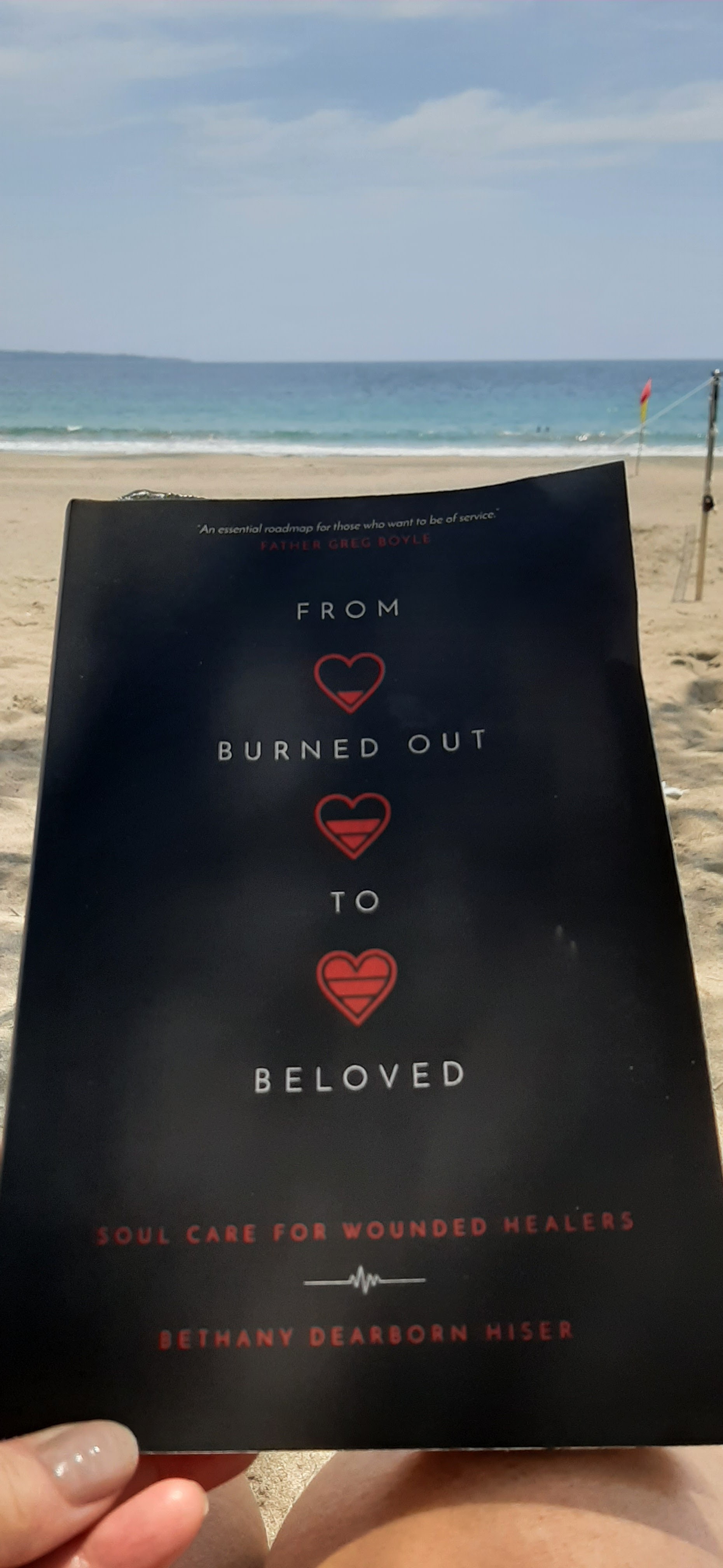
Book Review: FROM BURNED OUT TO BELOVED by Bethany Dearborn Hiser

From Burned Out to Beloved: Soul Care for Wounded Healers

by Bethany Dearborn Hiser

*Please note as an Amazon Associate I earn from qualifying purchases.

Bethany has worn many hats that involve “secondary trauma”, so her book comes from a place of experience and understanding. She invites the reader into her own personal story of burnout and recovery. She explains that trauma affects everyone who is exposed. This includes the people who listen to the stories of survivors. This is “secondary trauma”.

The back cover really describes this book well: “It’s a trauma-informed soul care guide for all Christians working in high-stress, helping professions.”

The book is divided into four-parts titled: Centering, Unpacking, Recovering, and Thriving. Each chapter offers reflection questions to help the reader process and tend to their own souls. She also provides exercises to help, as well as, other resources for further help and guidance.

Bethany doesn’t offer answers or a prescribed formula, but rather guides the reader in their own journey to taking care of their own soul.

I highly recommend this, but with a few warnings. Know that you will need to slow down and make space in your life to do the hard work. It will take time, and that this book is to help prevent burnout. So, if you are passed prevention, seek support from a trusted counselor who can walk alongside you.

Book Review: EXPECTATIONS and BURNOUT by Sue Eenigenburg and Robynn Bliss

Expectations and Burnout: Women Surviving the Great Commission

by Sue Eenigenburg and Robynn Bliss

*Please note as an Amazon Associate I earn from qualifying purchases.

Sue Eenigenburg’s dissertation linked expectations women serving on the mission field have of themselves or others thrust upon them to burnout. She explores expectations that women have of herself, her sending agency has on her, the sending church may have, her co-workers, the host culture, and even expectations she may have of God. When these expectations go unmet they can cause stress, anxiety and even frustration which if left covered and not exposed and dealt with leads to burnout.

Robynn Bliss adds the human touch to the research that Sue has done. As an ATCK, Robynn shares her story that led to her experience of burnout. She is vulnerable and real with the hard truth of her own expectations and how she tried to push through.

This book is not just for women on the mission field, but it is a great resource for sending churches, agencies, or people in member care roles to help them evaluate their own expectations that they may have on their female team members. And then to find ways of adjusting procedures and policies to encourage these courageous women of faith to continue to thrive, not just survive in the place that God has them.

Changing the Way I View Good-bye

“Good-bye!”

I’ve never really liked that word, though I’ve written quite a bit about it. I’ve written about how we should teach our kids to say it, how important it is, a great tool to use to go through it, and how I just feel that it stinks. I mean it sounds so final and ending. When I moved to China I learned the word for Good-bye (再見/zaijian) really meant “see ya later!” ~ my translation, but fairly accurate as it has a meaning of seeing the person again. I remember grabbing that meaning soon after my arrival. It was the bandage to my bleeding heart just after having left my family. The hope that I’d see them in a few years, that the good-bye was not final.

But, what if something happened to one of them and it was my final Good-bye?

The thought had plagued my mind at various times that were usually not convenient – like staff meetings or in the middle of the night when I should be sleeping. This thought turned into a fear. The definition bandage was not enough. I needed something stronger. Out of my comfort zone, away from dear friends and family who had always wrapped up my fears with encouraging words and support, I clung to God’s Word. Hebrews 11:13-16 spoke loud and clear to me.

“All these people were still living by faith when they died. They did not receive the things promised; they only saw them and welcomed them from a distance. And they admitted that they were aliens and strangers on earth. People who say such things show that they are looking for a country of their own. If they had been thinking of the country they had left, they would have had opportunity to return. Instead, they were longing for a better country – a heavenly one. Therefore God is not ashamed to be called their God, for he has prepared a city for them.”

(Heb 11:13-16, NIV)

Note that this passage is in the middle of the “Great People of Faith” list in Hebrews. Namely, Abraham came to mind. He left his home and family and just started out on a journey that he had no idea where he was going or when the traveling would end. Yet, he went in faith. I am no Abraham, but his example encouraged me to stay where God had placed me.

My fear became reality.

Death eventually did come. My grandfather. My grandmother. My own father. Each was difficult. There was grief. A few days before she died I talked on the phone with Grandma, the tomboy of a grandmother whose farm had been my second home. We both knew it was coming, and yet she encouraged me to keep doing what I was doing. We talked like we’d see each other again. I grieved, but understood and knew that we would see each other…one day.

A few years later, the phone call came that my dad was on his deathbed. He had battled leukemia for many years, and it had began to attack his body again. His immune system was shot – pneumonia snuck in. My siblings shared with me on the phone that he was peaceful those final hours. My mind raced to the last time I had seen him just five months earlier. I remembered as I hugged and told him good-bye wondering if it would be my last. As I hung up the phone I realized that my dad knew it would be. I remembered the look in his eyes as it seemed he wanted to tell me something, but being a man of few words he patted my back and choked out “I love you.”

As the years pass I know I’ll experience more deaths. We are mortal. It is part of life. Through these years of moves and watching countless others move out of my life, the Chinese meaning of Good-bye has changed from a bandage to more of a reminder of the passage above. Taipei is not my home; nowhere on this planet is really my home. I’m just a traveler passing through this life until the Lord decides to take me to my real home. A place where there is no more tears, no more pain, no more Good-byes!

Until then, I feel that I must live the life that God has asked me to live – not for myself, but for Him who through his death and resurrection made the harshest of good-byes of this earth just a “see ya later!” I know there will still be grief, but in the midst of that grief there is hope – that sure knowledge of knowing what will come. And for that I’m forever grateful for his saving grace.

This post was inspired by The Groove and is part of a link-up with Velvet Ashes. Thanks for letting me share a bit of my heart today. Please feel free to comment below or to contact me via email.


TCK Mentoring – Sea Change

Yesterday I had the opportunity to listen in on a webinar given by Sea Change Mentoring. This organization, founded by Ellen Mahoney, is designed for third culture kids from the ages 16-23, although they are open to reaching out to help children as young as 13. Read their mission below:

“Help international teens develop into happy and successful adults through the power of mentoring and our tailored curriculum.”

Ellen is a TCK herself. She shared her story with us of the time she returned to the US for university alone. It was a very hard year as she felt lonely and even depressed. She found out that she was not the only one – that many of her other TCK friends were also experiencing the various degrees of the same feelings. Throughout her life she has helped children. She began as a high school teacher, then began working with an online mentoring group in the US, and now is the Founder and CEO of Sea Change Mentoring.

So what is Sea Change Mentoring?

It is just that – mentoring third culture kids through all the change that they go through. The mentoring is currently being facilitated through Skype by professionally trained mentors that have overseas experience. They use a tailored curriculum for TCKs that was developed by a TCK. Some of the “units” that are covered are Building Strong Relationships, Healthy Good-byes, Career Exploration, Career EQ, Becoming Independent, and much more.

Why is this so important?

We all know that the expat life is much like sea waves, coming and going. Children may have a difficult time adjusting or connecting with friends. This program is designed to be a 2-3 year commitment allowing the mentor time to help the child go through changes, nudging them to build heathy relationships, as well as other issues they may be facing. And for those that are older, to help them begin to think about being independent BEFORE they are independent. We as parents can help, yes, and we should be involved in this process – but sometimes a third party that is standing on the outside can see the whole picture. Possibly even better since this person understands all the emotions that our children are going through. Sea Change works with the child, but they also communicate with the parents – which I found, as a parent, to be comforting. Sea Change was founded in 2012 and launched their first pilot program this past January. So, it’s fairly new – but I don’t believe there is anything like it out there for TCKs. If you have children in this age range and wondering how you can help them with adjustment, this might be a really good option. If you would like more information, you can click here.

**I just want to note that I did not receive anything for this review, but that it is solely my own opinion from what I learned about through the webinar.

Beware of Your “Friends”

Moving Books

Photo by Kaptain Kobold at flickr

We’ve just recently moved. Finally. We have spent the last three months looking for an apartment near the school. Unfortunately, we moved during the first week of school. It was definitely stressful, but I was able to make a new BFF. Though now, I’m regretting that friendship.

This BFF was convenient. She knew that teaching all day and then packing was too much for me to make meals, so she always had meals wrapped up and ready for pick-up. She also was super knowledgeable. She understood that my girls would be bored since their toys had been packed, so she graciously packed a few small toys inside the bag for them. It was such a great source of entertainment those last few stressful nights of cleaning the old place and unpacking the new place. She just knew. It was great until I got on the scale.

This BFF was that fast-food restaurant that conveniently had a drive-through. Drive-throughs are fairly rare on this island, but they were conveniently placed in our path during that transition time of the old place to the new apartment. I *gulp* fell into the “Convenient Trap” because it was so much easier than chopping, slicing, and cooking up a nutritious meal.

Fortunately, after we moved a few real friends brought over some healthy meals to help us out. That was the turning point back to healthy eating. Those meals gave me the energy to do what needed to be done in the new apartment so that I could begin cooking my own healthy meals again. My kitchen is still not in complete working order, but it is enough that I can cook simple healthy meals. For that, I’m thankful because I want to eat healthy and I’m seeing the scales looking better already. *whew*

If I could have done this move all over again I’d do a few things different, like…

1. A few months before the move make larger portions of meals and freeze them. That way, they’d be easy and quick to put into a microwave to warm up.

2. Buy bread, peanut butter/nutella, fruit and veges (cut and bagged). Something quick for lunches.

3. Buy lots of paper plates, cups, and plastic utensils. Though, not the most healthy for the environment, it makes it easier for those first few days of transition.

*Note that if I was moving to another country, I’d only do #2 and #3 once we were there. The first one is not really an option. *grins*

Your Turn: What is something you do when you are moving that helps with the transition? Share in the comments below.


Mamas Need Their Outlets, too!

Golfers on the Coral Gables Country Club

photo from The Commons via flickr.com

Schools are starting back up for many around the world. For some families that means getting routines set, taking one last holiday, but for many others it is setting up the new home and getting the kids excited to start a new school – or at least helping them to adjust to a new school.

Women's Curling Briar

photo from The Commons via flickr.com

What happens on that first day though, once all the kids are dropped off at school and you return to a quiet home? Do you collapse in wonderment? Do you get a fresh cup of coffee to slowly savor without distractions? Housework? Chores? Cry?

What do you do? You need an outlet, too! A place where you can laugh with friends, discuss or chat. You just need a place where you can be you, the person – not the mom. Don’t get me wrong, I love being Mom. It’s just that once in awhile it is nice to have adult conversations and to eat at my own pace my very own dessert.

What do these “places” or groups look like? Some cities have regular set dates that an expat group has organized. Other cities may not have anything set, but maybe the school has a Mother’s Tea where you can meet other moms. This group could be a Bible-study, book club, or any other small group gathering that meets for a certain purpose.

Why should you get involved in a group? Women in general support each other and talk – as Apple Gidley in her book Expat Life Slice by Slice says, “…international women groups around the world, whether a luncheon group, a tennis club or a sewing group are expatriate man’s best ally” (p40). I so agree with her on this because who understands our situations better than another expat mom? We become fast “sisters” helping and encouraging each other.

How do you find these precious gems? You have to look for them. Ask other mothers at the school what there is to do. Find out if your city has an expat magazine or website that lists activities that would interest you. If there isn’t, you could start one. I’m sure there are others out there who would love to go out for coffee, too!

I’ll leave you with this last tip from Apple in finding a group: Make sure it is international, not made up from solely one country. She says that, “Instead of celebrating the differences they {mono-culture groups} tend to moan about them, whereas international groups are more forgiving” (42).

So, go out and find a group and make some friends of your own. Already in a group? Watch for the new moms and invite them to join – be a bridge to help them settle into their new home quicker.

*Although this is geared towards the mother as the trailing spouse, there are groups out there for dads/guys as well, but I find that guys don’t tend to “need” this close bonding friendship like women do.

**Thanks to Janneke at DrieCulturen for giving away the book Expat Life Slice by Slice by Apple Gidley.

Related articles

Enhanced by Zemanta

The All Time Hated Aisle

Cereal Aisle

photo by Rex Roof via flickr

Can you guess what the all time hated aisle for any expat is? Okay, the photo gave it away if you were wondering.

I don’t have solid research on this, but I believe this has to be one of the top 5 places expats hate to visit in the US. I have this theory because, having lived overseas for a-hem several years now, every expat I have talked to gets the same look and pretty much says the same thing, Oh, I just stand there for hours looking at all the choices not knowing what to put in the over-sized cart.

What is it about that aisle? I like lists if you haven’t noticed, so here are my lists of why cereal aisles make us tense up.

1. The aisle is a mile. Have you noticed this? I mean it is the entire length of the aisle and at least 4 shelves high. The pure size of it overwhelms me.

2. The number of choices. So, the aisle is a mile long and each shelf has rows upon rows of every kind of cereal you can imagine. Take for instance a simple flaky type cereal. You can get it bran, frosted, fruity, low-fat, and, and, and. And if you know what type of flake you want, then you have 4+ brands to choose from. I’ve gotten used to only have, at the most, five choices to choose from. Period.

3. The shouting of words. I’m a writer, so words tend to jump out at me. The cereal boxes are no different. I feel like the boxes are shouting their greatness, their newness. “Low-fat!” “Low-carb!” “Healthy Eating!” “Great for the Heart!” And that doesn’t even cover the “prizes” that are inside ~ which my kids have now figured out. I think having lived overseas I can’t always read what the boxes are shouting, so it is like they are on mute. You think?

So, what to do about this “problem”? I haven’t totally figured it out. My plan thus far has worked out fine. I tell my mother what kinds of cereal we “like” and let her bring them home. Then when we need to buy more, I search for the exact same box ~ if the kids liked it that is.

Your Turn: Do you like the cereal aisle? How do you tackle it when you are back in the US? Please share in the comments below.

If you want to read more, please know that you can get the posts delivered to you inbox. You can subscribe at the top right of this post. Thanks!

Enhanced by Zemanta

CPR/First Aid trained? Why you should be, especially if you are an expat…

First Aid

*photo from flickr

CPR stands for Cardiopulmonary Resuscitation, which is a medical term that means heart (cardio) lung (pulmonary) revive to life (resuscitation).

As a teacher I was expected to keep up my certification in CPR and first aid, which I did. When I had my own children and decided to stay at home I did not re-certify. It was not expected of me and it was difficult to find a class where we were located at the time.

And then the day came.

We were in Germany packing to return to Asia. My husband was out with our son buying new shoes before we left. I was with the two girls squeezing the last of the necessities in the last suitcase. The youngest was taking a nap. Jie Jie, the non-verbal special needs child, was playing with toys in the playroom. Before I knew it though, she had slipped out of the playroom into the kitchen. When I found her she was bent over with drool dripping to the floor. She looked up at me with wide eyes and fear. She was choking.

My heart stopped. I yelled for my mother-in-law. She didn’t hear me.

I was alone. Bits and pieces from that CPR/First Aid class came to my mind.

I began the Heimlich. A few seconds later, which seemed to be minutes, out popped a blue plastic object covered in saliva. And then the greatest sound, a cry.

She was breathing again. We sat there on the floor crying together. I knew right then that I needed to get re-certified. Not because certification would give me permission or status, but because I needed to refresh my memory. It had been too long and I felt I had forgotten too much.

Just this week we had another experience with choking due to eating issues. My heart jumped, but because I just re-certified a few months ago it didn’t stop completely. I knew what to do.

It made me think, though. Are you certified? If not, why? Here’s why I think you should be, especially if you are an expat-parent.

1. Alone. You could be the only person with your child when that time comes. Husbands travel, housekeepers have days off, and neighbors vacation. Knowing these simple skills can really save your child. Another tip: Have a SOS number of a friend who speaks the language who you can call if more assistance is needed.

2. Language. The emergency operator may not speak English. Having a little CPR and first aid training can give you a head start on saving your child. Use that SOS number of a friend who does speak the language. Have them call while you are administrating CPR/first aid.

3. Time. In cases of choking, you don’t have time to call for help. Knowing what to do can help reduce further injury from pushing in the wrong spot.

I hope that you never have to administer CPR/Heimlich, but if you should one day, I do hope that you have taken a class. I’m so thankful that I was able to get re-certified here in my city. I highly encourage each of you to find a class, whether in the city you live or when you go back to your home country. It is something you won’t regret.

Enhanced by Zemanta