
Book Review: WHEN MY NAME WAS KEOKO by Linda Sue Park

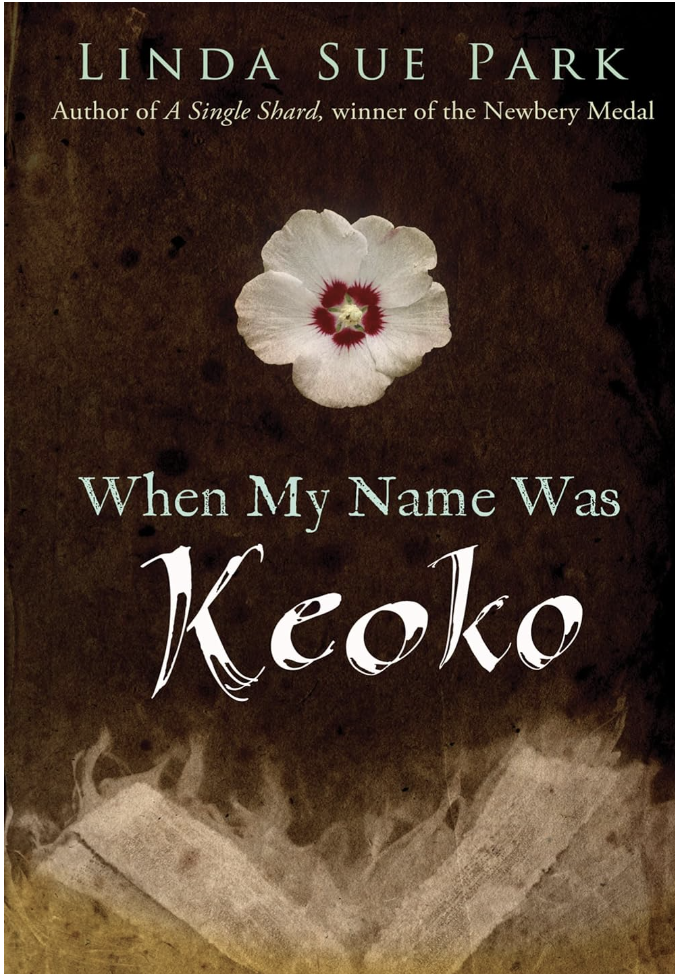
When My Name was Keoko

by Linda Sue Park.

Published: 2012

Genre:Middle School Historical Fiction

*Please note as an Amazon Associate, I earn from qualifying purchases.
Screenshot 2023-11-23 at 8.52.44 AM

WWII did not just affect Western countries, but it also affected Asia as well. Linda Sue Park shares an Asian point of view through her gift of storytelling. We watch the events of WWII unfold around Sun-yee and Tai-yul, a Korean sister and brother. 

As the term “Third Culture Kid” expands to “Cross-Cultural Kid,” I believe this book represents some broader aspects. 

  1. The characters are CCKs: The children at this time were more like CCKs, or “domestic TCKs” in their own home country. The Japanese occupied Korea. They tried to replace the Korean culture with Japanese culture. One way was by changing everyone’s names to Japanese names. So, Sun-yee became Keoko, and Tai-yul became Nobuo. Throughout the story, the family struggles to hang onto their Korean culture by trying to teach the children what it means to be Korean.
  2. Language is essential: Korean was forbidden during this time. All classes were conducted in Japanese. No one was to speak or write in Korean. Because of this, the Korean language was almost lost. Sun-yee’s father saw the relationship between culture and language, so he secretly taught her the Korean alphabet. For many non-English speaking families, the language struggle to ensure the children do not forget their “mother tongue” is real.
  3. To see the human being: I mean not being judgmental towards other nationalities. Before the Japanese came, Sun-yee’s good friend was the Japanese neighbor boy. As tension builds against the Japanese, Sun-yee becomes confused by what the Koreans say about the Japanese. Her friend is not like those descriptions. When she is older, she does become friends with the Korean girls, but she never has harsh feelings about her neighbor. They help each other out at different times. TCKs/CCKs have the opportunity because of the international schools/communities to see past prejudice and see the person for who they are, not the country their passport says they are from.

Meeting a Famous TCK

Before the flu hit our family like a vicious creature from the black depths of the sea, I had the opportunity to listen to a John Newbery Award author speak at one of the International Schools here in Taipei. Linda Sue Park to be exact.

She’s a TCK, really!

I’m not sure she’d call herself a Third Culture Kid, but I do. Her parents are US immigrants from South Korea. Most of her books are tied back to South Korea in someway, which I love. Her curiosity of her parent’s life before America lead to questions, which lead to story ideas.

She was inspiring…

I’m not Korean, but I was inspired to share my stories and to find out the stories of my family to share with my own children. My kids should know about their great-grandparents and how they survived the dust bowl of the 30’s, how their grandparents survived WWII in Germany/Prussia, and how their parents grew up on opposite sides of the world yet still met and married.

How do you share family stories when you live on different continents?

Stories are usually shared around the table at family gatherings. I grew up in a family that met every Sunday after church at my grandparents’ home for lunch. This is where I heard many of the family stories, but my kids do not have that same opportunity. We live on a different continent and see them every few years.

What to do, what to do…

Be proactive. Keep a journal with the questions you want to ask. Get your kids involved if they are old enough and ask them what they want to know. Buy a book that already has the questions written down. Then spend time with those loved ones and find out the answers. You could even video the question/answer time so your children can watch it later. Your kids may not be that interested in it right now, but someday they will be – and when that day comes wouldn’t it be more fun to have a video or book to look at together than to just stare at them open mouthed and say, “I don’t know.”

My in-laws are visiting in a few months – I need to get that journal bought and ready.

Your Turn: Have you thought about your family stories and how you are going to pass them down to your kids? How have you managed it? I’d love to hear your thoughts and responses below.

Enhanced by Zemanta