The US Dialect Quiz and TCKs

Maybe you’ve seen the US Dialect Quiz roaming around on Facebook. The quiz is from NY Times and questions are based from the Harvard Dialect Quiz. Basically, you answer twenty-five questions about how you would say certain words or which word you would call an object. Then based on your answers a map is shown where in the US your dialect comes from.

Any expat parent that is not a citizen of the US can probably say that their child has “lost” some of their accent. I know this to be true because my German husband has an American accent. As a teacher I have seen students from other countries speaking with an “American accent,” this includes countries where English is the official language. I vividly remember many years back a little Korean first grader saying good-bye to her teacher in a southern drawl – no hint of a Korean accent. And now, I see it with my Auzzie, South African, and even New Zealand friends – their children have only a hint of their “home” country’s accent.

So, what about an “American” TCK – yes, they most likely will have an “American accent,”but even the US has many varied accents and even vocabulary words. I had two thoughts about this quiz: 1) I wondered if my accent/dialect would be different since I’ve lived overseas for sometime now and 2) if my children would be relatively close to my score. And then the question of just wondering where my husband’s accent/dialect fell since he has an “American accent,” but had only lived there for a total of four years for university (two years on the west coast and two on the east coast).

The results? I scored southern Missouri/northern Arkansas, which I’d call the Ozark region. I grew up in northern Missouri, but went to university in southern Missouri. So, okay I’ll take that.

I had my oldest take the quiz. He scored Washington state.

And my husband? St. Louis, Missouri. Maybe I have had an affect on him after all, or the east and west balanced out? Actually, probably neither.

My thoughts on this? I believe that my son’s language has been affected by his teachers and his classmates just like all other expat children. As I think about it, he has had teachers from Washington state and Canada. And I bet if I asked my husband, his accent would probably be because of teachers and coaches.

I’m not the only one finding this quiz to show a differences between child and parent, though. A friend of mine also discovered the same thing. She scored Texas and Oklahoma, while her son scored North and South Carolina.

So is this breaking news? No, but it may give us another example of why our kids don’t feel “at home” in the place we may call “home.” It is a tiny example, I know, but still an example.

How about you? Have you taken this quiz? Has your children taken the quiz? What were the results? Please share in the comments below.

Counting My ….

A few months ago we moved to a new apartment. There are things that I like about the new place. For one it is just a three minute walk from where I work and the kids go to school and it has a fair amount of storage space.

And I like this….

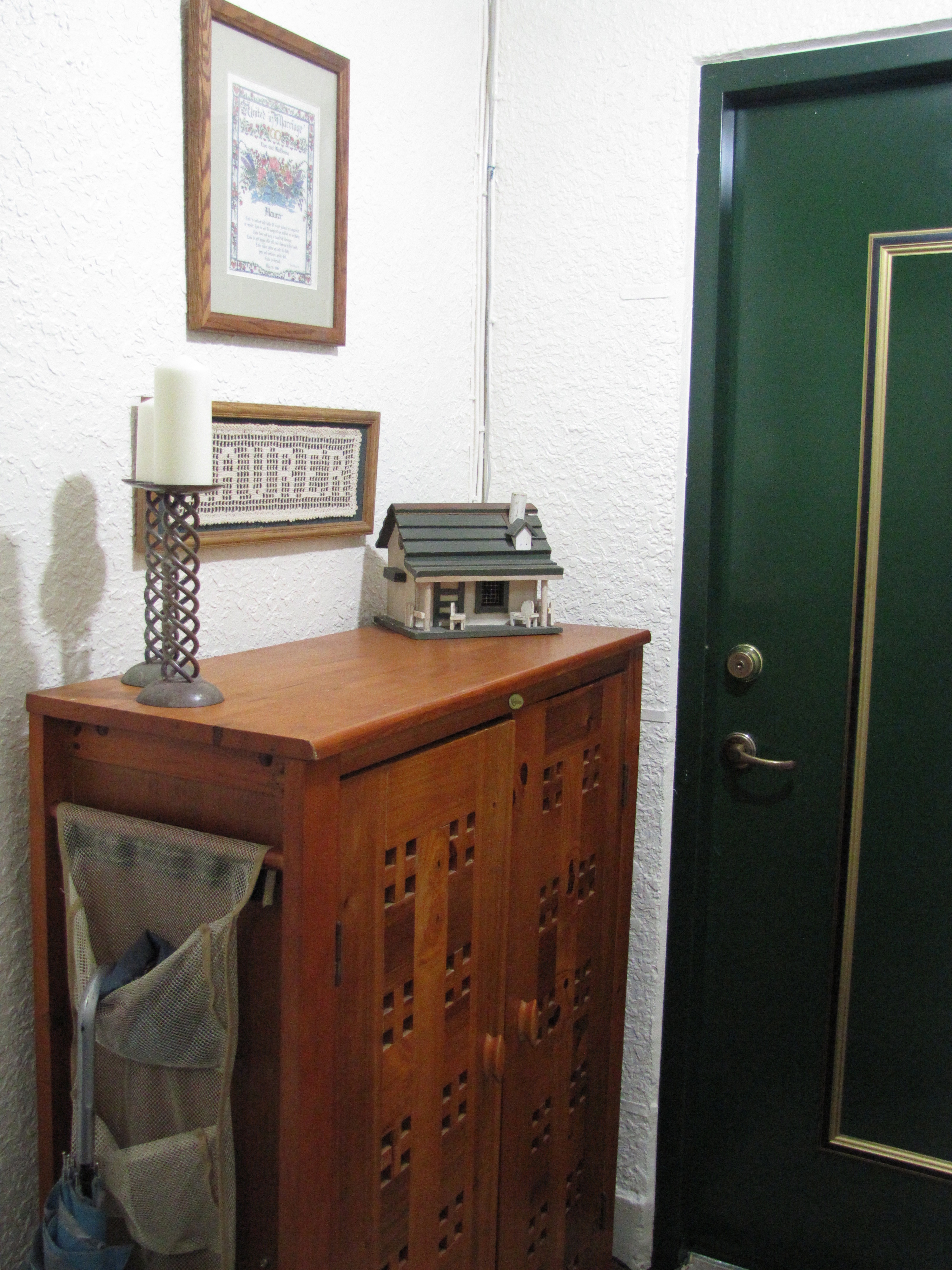
We have a small entrance way into our apartment.

We have a small entrance way into our apartment.

And this…

This Japanese Tea room is now the play room for the girls. If it's too messy, just shut the doors.

This Japanese Tea room is now the play room for the girls. If it’s too messy, just shut the doors.

But that is it – really. That is ALL that I like about it. I don’t like that the bathrooms are not big enough for a bathtub. Or that the living room is SUPER dark – think cave. And, please keep in mind that I am not new to Asia, but having six neighbors – and this is not including those living below or above us – living so so close makes me almost crazy. I’m talking so close that I can reach out and water the plants in the window of one neighbor and wash the windows of my other neighbor.

Don’t believe me? Check these out.

I can water your plants for you....

Our windows almost touch…and opposite side is the kitchen to another neighbor.

IMG_5413

I could almost wash the windows off my balcony.

This is what I’ve been whining about for the past few months since moving here. There have been other things that I’ve whined about, but this was what caught my attention to how LAME I had been. As soon as the photos started coming in from the Philippines, my head hung in shame. “At least I have a home….”

The whining had to stop. And it did for a short time…

And then Thanksgiving was approaching. And I was whining because our awesome plans to start a new tradition with the kids fell through. It was a week before and we had NO plans for Thanksgiving. Slight panic – then a friend at church asked us to join their family.

Last week was Thanksgiving and I had the greatest time in a huge church kitchen with a few other ladies to finish up the last touches for a gorgeous meal. I had the chance to pause for a brief minute and take in the beauty of family. The yelling as one uncle threw the long pass of a football, girls giggling about the baby, and the shrill laughter of the women in the kitchen (I’ll not admit to anything on fire, to which caused the excitement) – all of this caused a deep sigh in my soul. Not a longing sigh, but a grateful one. Grateful to have had time to cultivate friendships – to take time to stop and remember all that we should be grateful for this past year. It lit a fire in my soul to do this again…

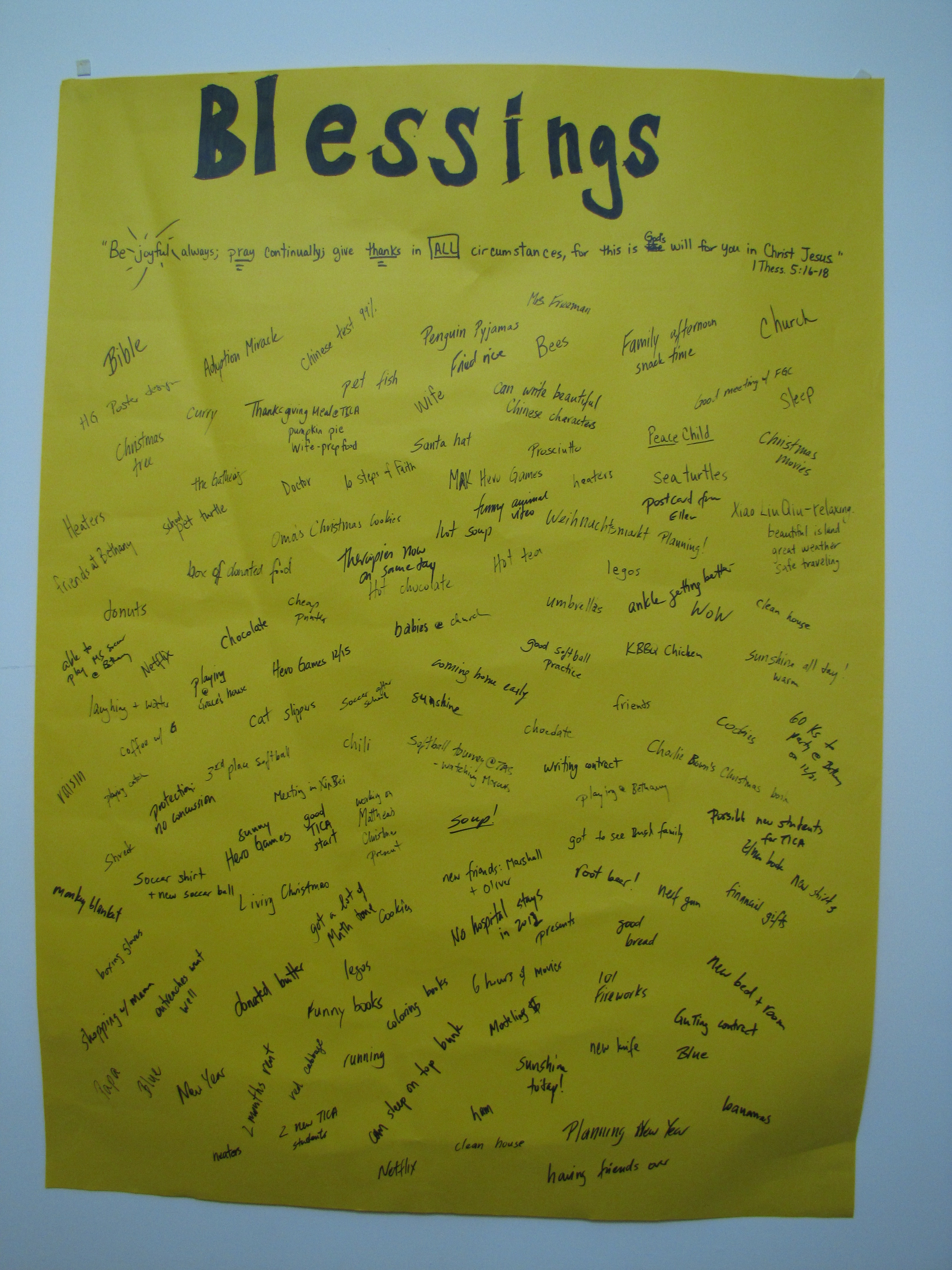
IMG_4407

That is our “Blessings” Chart from last year. I wanted our family to give thanks each day for things that God had done for us. I wanted it for my life and I wanted it for my children as well – so every night after supper we each shared one thing. We did this for almost two months. So, we’ve started it again. The day after Thanksgiving I taped up a new chart…this chart.

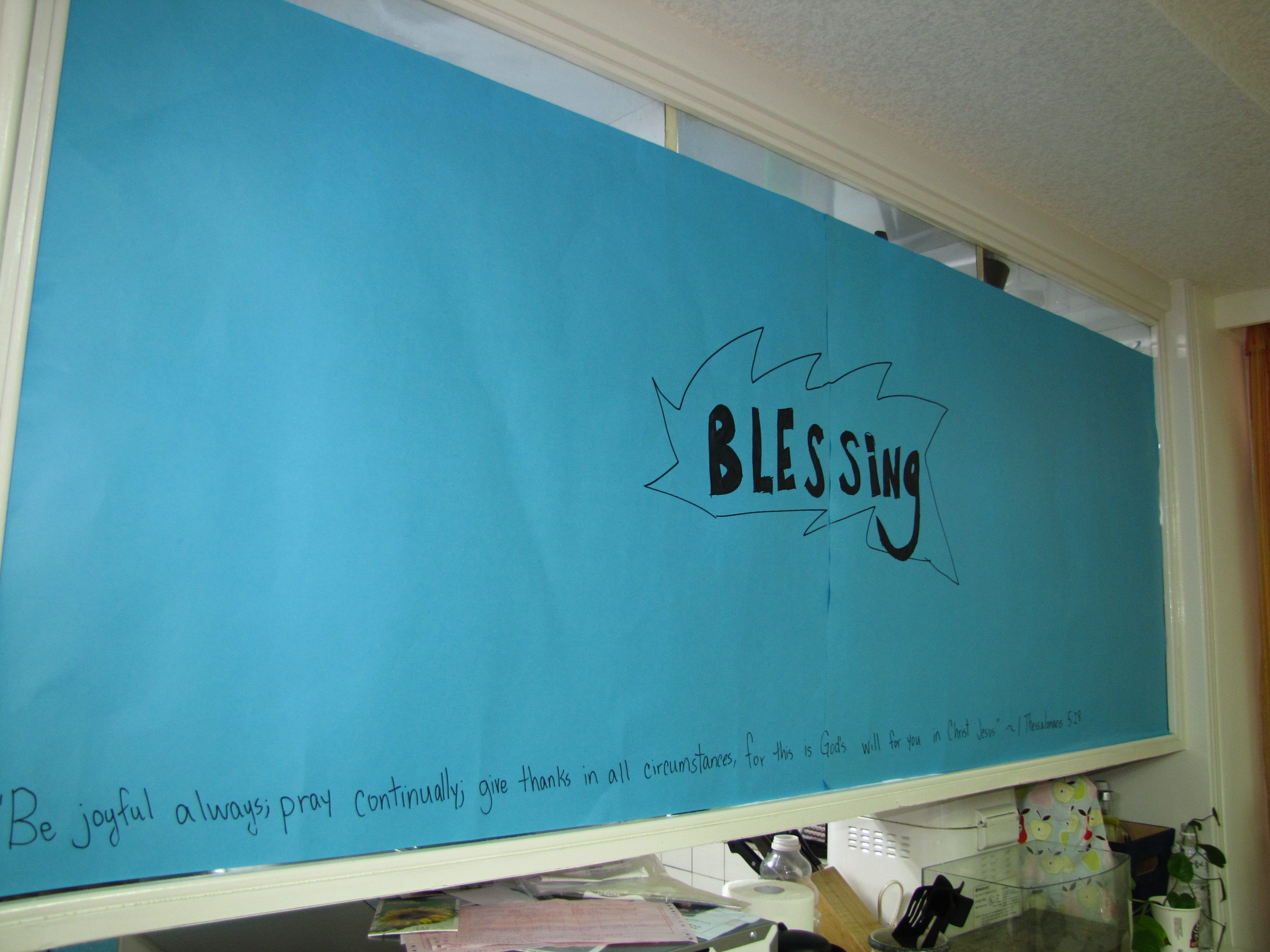
IMG_5417

It’s bigger and I’m excited to see what we will be putting up there. I’m also excited, as I know that when I have to think about all my blessings, that my whining decreases and I my thankfulness increases.

I don’t know if you are like me – wanting to give thanks and to have a grateful attitude, but find yourself singing your own version of the country western song “There’s a Tear in My Beer.” If you are like me, what do you do to stay positive? If you don’t do anything, I challenge you to do this or something similar for a month – you may find yourself doing it longer like we did last year. I’d love to hear how it goes if you choose to do it. Please share your stories below. I’m so encouraged when you do.

Expat Fathers Uninvolved?

That is the question that I have tried to tackle over at Expat Child this week. Here is a snippet of that article.

“Research has been published regarding the uninvolved father. The United States Child Welfare Department has issued findings that children whose fathers were involved in their lives have higher cognitive development, feel more emotionally stable, and are less likely to get involved in drugs or violence. It also found

that boys with involved fathers had fewer school behavior problems and that girls had stronger self-esteem. .

Are the TCKs whose fathers are absent for several weeks at a time doomed?”

If you want to read the rest, head over to Expat Child where you will find the full article.


Interview at Expat Child

Today, I’m over at Expat Child being interviewed. If you want to find out more about me and my thoughts about living overseas, then click here.

**I’ve been moving these past few weeks, so I’ve been quiet here. I’ve had a couple of you check in on me this week. Thanks for caring enough to ask. We are all doing well, just adjusting to new apartment and new school location.  *sigh* back to unpacking and lesson plans.

If you haven’t checked out Expat Child, you should. Great resource for those who are raising kids overseas.

Including Your TCKs….

I grew up in a family that worked together. What I mean is that my parents expected us to help each other out with family projects. For instance, every fall we helped Dad cut and haul wood; every summer we worked in my grandmother’s very large garden, and then at the end of the summer we canned everything; and as we got older we helped each other move into our homes. It is like that still . Almost every return visit there is usually some family project going on that we (my husband, kids, and I) help with. Like a few years ago we helped my brother-in-law build his barn; and last summer we helped my mother tear down an old building. Everyone that was able helped in some way, even if it was just refilling the water jugs.

My husband grew up somewhat the same, so he jumps right in and helps with no complaints when we are back. And because of this, we have tried to include our kids in whatever we are involved with while living overseas. When they were younger my husband was a principal at international schools, so I would take them to all the school programs. It was a way we could support him and be a part of each of those communities. When our kids were toddlers, we wanted them to learn to help others – so I had them help me pick up trash after school events or other small jobs that they could handle.

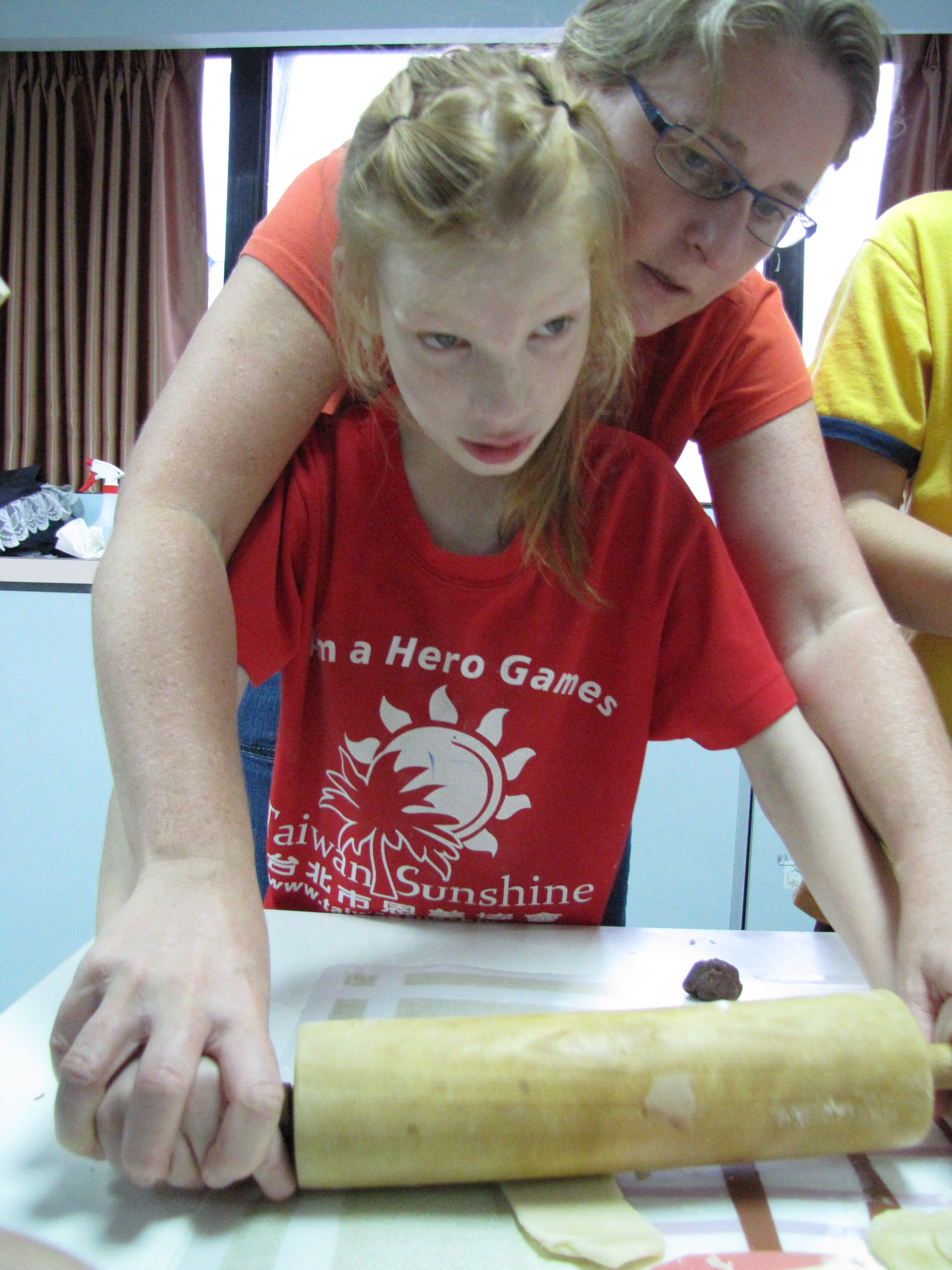
Now that they are older, our work focus has changed. My husband is now the director of a not-for-profit that helps families of children with special needs. We wanted to include all of our children, not just our child with special needs in this new endeavor. The other two “get” to help in appropriate ways like volunteering as a buddy for a child with special needs at activities we host or they help with the preparations. It’s a family project, not just my husband’s job.

20130518_101045

Why do we do this? We want our kids to feel involved in the work that we are doing. We want to them to experience different aspects of life, not just what they see at school or with their friends. We want them to do something meaningful. I just read an article* that says that “adult MKs who felt they were a significant part of their parents’ ministries had, as adults, a greater sense of spiritual/emotional stability” (“Raising Resilient MKs” by Diane Morris). That MK, could be replaced by TCK for those who are working with humanitarian organizations. I believe our kids need to see what we do and why it is important.

Do we force our kids help us? Honestly, sometimes, but not always. We ask and see if they want to help out, especially if it is volunteering to help other people. We challenge them to try it, but we don’t force them to volunteer if they are uncomfortable. Now, we might force or bribe them to help with preparations when we need extra hands to sort T-shirts and medals, but most of the time they do it because they want to – but not always. They are children.

“But, I work with organizations that work against child trafficking and sex-slavery, there is NO way I’m bringing my children anywhere near those places,” you say. I hear you. I wouldn’t either. I want to protect my own children’s innocence as long as I can. I’ll be honest, this is not an area I’m an expert in – but I’ve had my kids help me make cookies and color eggs that were to be delivered by another organization to “tea shops” where some of the women worked. My kids did not and still do not know what kind of work these ladies do, just that we were making cookies for some people to make them happy. What kid does not want to make others happy.

“But, I’m not a missionary or a humanitarian,” you say. I still think you can get involved in something with your community. I’m sure you may already are. I know of other traveling spouses that volunteer at orphanages, help with fund-raisers for needs in their city, or other “humanitarian” type work. Try to work in times to get your kids involved with you. It’s great for kids to see their parents helping others, and it’s even better when you see them and can honestly say “Great job, today. I’m so proud of you!”

So, I challenge you. I challenge you to get your children involved with whatever it is you do. It can be simple like making cookies or it can be more difficult like building new homes after a natural disaster. Whatever you do make sure it is age appropriate, meaningful, and that you do it together.

Your Turn: How do you involve your children in the work/ministry that you do? I’d love to hear of more examples and stories, so please share below in the comments section.

*Taken from the book, Raising Resilient MKs edited by Joyce M. Bowers.

Enhanced by Zemanta

Expat Special Needs Parent: Marriage Homework

Expat parents of children with special needs know a few secrets. They experience

wedding picture

loneliness, and the feeling of “alone-ness” like other expats, but many times even more so. Let’s face it, between therapy sessions, outbursts of children, and the mobility of the expat community these seasons of being lonely are often. The last secret that expat parents of children with special needs know is the secret of marriage: Being married is super hard work

Divorce rates are extremely high for parents of children with special needs. Many sites like this one, states that the rate could be as high as 90%! That is high! I don’t know what the rate of expat parents are, but I’m sure it can’t be too far off from that statistic.

Why is the rate so high? Stress is the simple answer. Stress of money or lack of it. The cost of the various therapy classes, the surgeries, and the medical equipment required for the child is not cheap, and depending on the country you live in it can even be more expensive than in your home country. It all adds up quickly. The other factor is the stress from the demands. Children with special needs require a lot of attention. They splatter Nutella, they climb into the bathtub fully clothed, and many are toddlers running around in bodies of a preteen. The time it takes to teach, re-teach, and re-teach again just basic living skills takes away from time together as a couple. If you have other children in the home, then more time is needed for them as well. Not spending time with your spouse causes stress on many levels – communication, intimacy, friendship, etc.

With odds like that, it seems hopeless – even to me.

Hope is there, though…

It is there for me because I choose to not dwell on that 80-90%. Instead I focus on the 10-20% that I want to be in. My husband and I made an agreement when we were married that we would not even joke about divorce. When Jie Jie was diagnosed and we read the statistics, my husband boldly told me that we would work harder to maintain our marriage, that he’d work harder to keep our marriage a priority~I’m such a blessed woman.

Has it been an easy road laid with flowers and fairy-tale music playing in the background? Wish I could say YES, but I have to be honest. It has been tough, and I mean T.O.U.G.H. I’m married to a great guy. He is. He’s patient with my emotional whacked out side that comes out after I’ve had five days of not much sleep due to a little girl (or two) walking around the home in the middle of the night. He’s great, but he’s not perfect. And sadly, neither am I. It takes work.

I want to share with you what we do to keep our marriage strong. We’ve been married for 14 years this July, but these idea were shared with me from couples that have been married much longer than we have.

We choose to make time for each other. That’s it. It’s simple, but it works. We’ve had seasons of “date” nights, where we went out once a week on a date. We had a friend that could watch the kids and we’d catch a movie, supper, or something as simple as coffee. Now, we are not able to go out as often, but we still take day trips or spend a night at a local hotel every once in a while. Since we can’t go out as often on typical dates, we take an evening walk. We are able to do this after the girls are in bed asleep and our son is still awake. We walk around our neighborhood and talk about jobs, problems with kids, future moves, and whatever else that comes to our minds. It’s been a great way to stay connected.

Your Turn: Maybe you don’t have children with special needs, but what do you do to keep your marriage strong? Please share in the comments below.

You can receive new posts in your email inbox by signing up on the far right. You can also join the Facebook page and get up-to-date info from other articles on raising TCKs.

Enhanced by Zemanta

Make Sure To Say Good-bye

It’s the end of the school year, which means traveling with family, moving to a new place, or hanging out at home. Most parents and teachers of third culture kids know that they need to make sure there are opportunities for students to say good-byes properly. They have “Good-bye Parties” for their children; they take photos of their favorite places, and/or they have dinners with special people before they leave.

Alloway Kirk and Burial Place of Burns's Family

Photo by The Commons at flickr.com

Saying “Good-bye” well is something we should have our children do at the end of every school year or long vacation no matter if we are leaving or not.

Just last week I put in a music DVD for Jie Jie that we’ve had for over ten years now (Have DVDs truly been around that long now?). She requests it once in awhile, and on this particular morning I sat and watched her dance along with it. A song came on, this song in particular, and my heart wrenched.

I was flooded with memories from 10 years ago.

It was the last week of our time in Shenyang, China. Due to SARS, the school had ended a week earlier. My husband was the principal at the time, so we were making our last rounds of dinners and lunches with various people. This day we happened to be eating fish head soup with a Korean family when my husband got the phone call. An elementary student had gotten pinned down by a large iron gate just outside his home. He was dead.

In a haze of confusion and pain, a memorial service was arranged. The students who were still around all showed up, along with teachers and friends of the parents. “With All of My Heart” by Jana Alayra was one of the songs that was played that day. It had been one of his favorites.

Many of his classmates were not there that day. They had already traveled back to their passport country. *

We can’t know for sure that when school resumes in the fall, that your child’s classmates will all be there. So, if you have the chance help your young children say “Good-bye” well this year. Maybe it it’s just a handshake and the words spoken or maybe you go all out and have an end of the year party where the kids say something nice about each other. Either way, from this experience, I learned the importance of saying “Good-bye” every time.

*The school had another Memorial Service in fall for all the students, along with counselors to help them deal with such a huge loss.

Your Turn: What do you do to help your child/student say “Good-bye” at the end of the school year? Please comment below.

Related articles

Enhanced by Zemanta

Combating Alone-ness in Expat-land

A few weeks ago I wrote a response to an article I read about raising kids with special needs and the reasons I think that they run true for an expat. One of the reasons was “Loneliness” due to mobility of expats and the fact that we live so far from family. This week I want to look at “alone-ness” which is different than being lonely.

IMG_3865

From the Merriam-Webster online dictionary, “alone” means to be separated from others. As a parent of a child with special needs, I do feel at times “separated from others.” The needs of Jie Jie are not like the needs of most expat families.

Jie Jie was tube fed her first six years of life. When visiting family in the US, we’d have checkups with the doctor and I’d stock up on feeding supplies that we needed to get us through a year or two. One spring, we had enough feeding tubes to make it back to the US – or so we thought. At church one Sunday morning, her feeding tube came out. Normally, this is not a huge deal because I always had one on hand for emergencies. The problem this Sunday was that the “emergency” tube was the one that broke. We had no more. We were able to creatively keep the tube inserted and feed her until we could see a doctor. Alone-ness surrounded me – although every single expat wanted to help, none could.

I was separated out from the others.

We contacted the company that made it and they located the exact feeding tube we needed in the same city that we lived in. The doctors there had just started using that type of feeding tube, so they were quite a bit more expensive – but we could get it the next day.

So, how do I combat this feeling?

1. Make friends with the locals and search out other expat families. There is a language barrier sometimes, but I have found a few who even have the same syndrome as Jie Jie. I am able to ask what is available for treatments, where to buy things, and even what they do for various situations. If you hear of another family, contact them and find out what they know and do with their child. I just recently discovered online speech therapy this way.

2. Online communities. Since Facebook, groups have formed for all kinds of things. I have found one that is a community of families that have children with the same syndrome as Jie Jie. It is here that I can post questions about development or other questions I feel I can’t ask. I also gain encouragement from the others that post about their children

3. Pray. Yep, I pray and ask God to give me wisdom in each situation. I go back and remind myself of his promises, his faithfulness, and his goodness. I remind myself that really, I am not alone because just as Moses promised Joshua, in Deuteronomy 31:6, “[God] will never leave you or forsake you,” I know that as a follower of him, he will never leave me or forsake me either.

So, though at times I have felt very alone and even hopeless – I’m not. There are people around me. I have a great husband who is a great team player, but we do have to be active in protecting our marriage. I’ll be writing a post on this huge topic soon.

Remember that you can like RaisingTCKs Facebook page or subscribe to get an email with the most recent posts. Both are located at right of this page.

Enhanced by Zemanta

An Expat Special Needs TCK Parent

I recently re-read “6 Secrets Special Needs Moms Know But WON’T Tell You.” If you IMG_3649haven’t read it, go over and at least scan the list. It’s good and fairly accurate. I say that because I feel the same and I’ve heard the cheers from other moms out there. Like this mom, who was also inspired from this same article to write “Special Needs Parents“.

As an expat though, I think at times some of these truths could ring louder…and here is why.

1. Expats are mobile. We move, or our friends move. Like it or not, it is the nature of “expatland.” If we are the one moving, then it is finding new doctors, therapists, schools that have special education, housing that is safe for the child with special needs, and making new friends ~ and I’m not even getting into the emotional side of transition. If it is our friends that move, then new friends join the circle. Always changing…

2. Loneliness: Mobility can add to loneliness. The friend who understands your child, who forgives you for having to cancel the fifth coffee date that month because of something related to your child, the friend who always makes you laugh is no longer there. The time and energy it takes to invest in making new friends is exhausting ~ making one feel like it isn’t worth it at all. To add to this lonely feeling, going out in public and feeling the stares, the odd looks, or hearing the whispers is tough. This is normal in any country, but if you live in a country where the parents of children with special needs are believed to have “bad blood”, then one may not even want to go out.

2. Alone-ness. Not too many parents of children with special needs live overseas, so feeling “I’m all alone” haunts the mind of the parent. The internet forums for specific needs are a great resource for parents, but having someone in person who can relate to those struggles of living overseas is better.

3. Marriage. YES, this is so important and sometimes seems difficult. The divorce rate is very high for families of children with special needs. Couples have to work at their marriage to make it last. Most go on date nights every week, take weekends away without the kids, or even let the kids stay with grandparents for the week to have a second, third, or fourth honeymoon. As an expat, it can be difficult to find people to watch your children, especially if your child has special needs. People are not always comfortable and parents may have issues with finding people they fully trust – see #1 & 2 above.

So, why do we do it – live in “expatland?”

I can’t say for the other parents of children with special needs, but for our family I can say that we live here because it makes the most sense. It is not because we are against living in the US or in Germany or because we are hard-set on being expats. Nine years ago when Jie Jie was diagnosed, we were ready to figure out how to live in the US if we needed to. With no hesitation every doctor and therapists told us to return. So, we’ve taken it one year at a time.

We look at our whole family, not just Jie Jie’s needs. We look at our other children and their needs. We also look at what God is wanting us to do. Two years ago my husband quit his job as principal at the “American Christian” school to focus more on the nonprofit organization that he helped start called Taiwan Sunshine, which supports families of children with special needs. So, for now, this “crazy” expat life makes sense.

Next week I’ll share a few ideas to help fight those expat “heartaches” of being a mom to a child with special needs child.

Your Turn: What do you find difficult as a mom/dad to a child with special needs while living overseas? Even if you don’t have a child with special needs, what do you find difficult? Really I do want to “hear” what you say. Go ahead and comment below.

Also, remember that if you want to get the latest post, subscribe and you they will be automatically emailed to you. Thanks to all who have subscribed and shared my posts.

Enhanced by Zemanta

Awareness Week for Cri-du-What? Syndrome

Cri-du-Chat is French for “Cat’s Cry”. It is the name given to the syndrome that Jie Jie has. The syndrome was discovered 50 years ago by the French geneticist, Jerome Lejeune. This syndrome is also known as 5p- Syndrome or Lejeune Syndrome.

So much has changed in 50 years. One of the major breakthroughs has been not institutionalizing the children. For the past twenty years, or so, children with CdCS have been able to remain at home with their families – with the discovery that they actually develop so much more through the interaction and intentional therapy play starting at a young age.

The big breakthrough for me, as an expat, was the internet and communicating with other families that have a child with CdCS. I have been so grateful that I’ve been able to receive the services that I’ve needed to help our daughter develop and grow here in Taipei, but the lack of communicating with other parents has been difficult. Now, I’m able to check on the Facebook page or the website to get the latest information or to get a question answered. I don’t feel as if I’m wading through an unknown land without a map or compass. I know have fellow travelers who have gone ahead and left markers to help me navigate this new territory of parenting.

This week, May 5th-11th is the 2nd annual International CdCS Awareness Week. It is a time for the families to be a voice for their child who can’t speak up. It’s a time for us to encourage each other, to be excited that we are not alone, to cheer our children on as they develop more than we ever expected or imagined. If you’d like learn more, here is a short video that gives you a glimpse of what these kids can do.  I CAN

If you are living in Taipei or thinking about moving here with a special needs child, I wrote an article that just came out in Centered on Taipei‘s May issue titled “Living in Taipei with a Special Needs Child”.

Living overseas with a special needs child is not always easy, but neither is living overseas with children. Period.
Your Turn: Whether your child has special needs or not, what has been the most difficult thing about living overseas for you? Please share in the comments below.

Enhanced by Zemanta