Field-Trip Madness

We’ve been sick around here for the last few weeks, but I think we are now coming out of it. Finally.

A few months ago, I was thrilled to be asked by Carole at The Expat Child to write an article for her site. If you’ve not heard of this site, you need go and check it out. She has a wealth of information for parents relocating with their child(ren).

I had just survived a couple of field-trips with Jie Jie when I wrote this article. I shared some tips that I learned from the good, the bad, and the could have been ugly.  Here is a clip from that article.

Though staying home would have been easier, new experiences are good for her development – no matter how hard they may be for me. So, I took a deep breath, said a prayer and entered the pottery shop.

If you want to read the rest of the article you can click on the link: “Surviving Field-Trips with Special Needs Children”

Here’s some of my favorites from The Expat Child:

Jet-Lag and Children

Where is Home?

Step Out of Your Comfort Zone

Language and TCKs

“Which language should we speak at home with our children?”

“Which school should we send our children to? Language is important, but I’m afraid my child will forget or not master our ‘mother tongue’.”

As an expat parent, I’ve asked those same questions. As an international elementary teacher, I’ve heard those questions from parents about their own children.

They are legit questions, ones that should be addressed from the get-go when deciding to live abroad with your family. When I was pregnant with our first child my husband, being German, and I decided that I would speak English and he would speak German. Let me just say this, in theory it was a great plan, but for our family it didn’t happen. My husband rarely spoke German anywhere. His working world was in English and Chinese. His world at home with me was in English. He didn’t think about speaking German unless he was talking with his parents, but even that was a mixture of English, German, and a bit of Chinese. Please know that I do know of families that spoke dual languages and it worked wonderfully for them. It just wasn’t for our family. If you have a mixed family, this is definitely something you need to discuss as a family – which language(s) will we speak at home with our kids?

Schooling affects language as well…

Yes, which school do we send our child to? Local? International? Home-school?  These are questions that you definitely need to discuss with your spouse. Something to think about though, is what language do you see your child using as an adult? Is it your mother-tongue? your husband’s? English – if that isn’t your mother-tongue? As an educator, I can’t say this strong enough – Whatever language(s) you decide your child will be educated in make sure your child masters a language – and what I mean is they have mastered both speaking and writing. If your child cannot fully function in one language, they may never be able to fully express their feelings.

Once GeGe was almost pre-school age, Uwe and I discussed what language we wanted him to be educated in. We wanted him to be able to speak Chinese well. We had planned for him to attend local school until Grade 2, with me home-schooling him in English to keep up his writing. We chose this grade level because we knew that he would most likely go to an English speaking university. The English writing begins to expand quickly to paragraphs in grade 3. We didn’t want him to fall too far behind and not master English. Well, this plan didn’t workout for us. He attended only Kindergarten at the local school, then in grade 1 we switched over to the international school, but requested that he be in the same Chinese level as the native speakers in his homeroom. This worked out well for him. Our decision to pull him into the international school was due to the fact that Jie Jie needed to start school and her school was not at the same school. They were not really even close to each other and there was no way for me to get them both to school. GeGe could go in early with my husband, and I could take JieJie.

We speak English in the home, so these questions were not so difficult to answer, but for those expat parents whose language at home is not English this decision must be weighed out carefully. And many times a sacrifice of the mother-tongue happens. The language spoken by the parents is learned, but not fully mastered.

When raising kids abroad, the question about language is huge. It’s one that every expat parent must think through and discuss with their spouse. It is a question that my in-laws had to make over thirty years ago when they decided to send their very young children to the American school versus the German boarding school that was located in a different country. And it will be the question that probably my children will have to make should they choose to live abroad with families of their own.

Your Turn: What language do you speak at home? How did you make the language decision about education? What school do you send your kids to or did your parents send you to? Please share your thoughts in the comments below. I’m really interested.

This post was inspired by a blogpost I recently read about raising kids overseas. She is a TCK herself and understands the advantages and the disadvantages of living abroad. She listed questions one should ask when they begin to think about raising TCKs. The one suggestion that she gives to expat parents is to READ. Read books, articles, and blog posts about and authored by adult TCKs. If you are not currently following DrieCulturen, you should. Great resource!

Related articles

Enhanced by Zemanta

Keeping the Culture: US Independence Day

"Uncle Sam's Birthday. 1776- July 4th 1918. 142 Years Young and Going Strong."

Have you ever worried that your TCKs are going to forget or not know your home culture? Are you afraid that they are missing out on all the cultural festivities and knowledge about where you are from? That they are just not going to understand their heritage?

My kids are third culture kids(TCKs). Most of you have read my bio so I won’t bore you with details. In case you haven’t had the chance here is a shortened summary. I’m from the States, my husband is a German MK, and our kids are growing up in Asia.

Sometimes I wonder about the above questions. I know they are getting a great education. I know they are learning so much about the world by living overseas and going to school with children from all over the world. I’ve read books and have attended conferences to learn more about these resilient kids. I’m following blogs of top experts on the subject and even blogs by adult TCKs to gain more understanding. I do all of this and still I wonder.

I’m sure you do too, or you wouldn’t be reading this post.

So, what can you do to pass down your heritage to your kids?

Celebrate the holidays. Yep, this is one way I am doing it. Independence Day for the US is in a few days. I’ve had the opportunity to read part of this book to my girls. I’ve planned crafts and activities to do with them as well.
Since we are in the US, we will get with family and grill and celebrate together. We might even be able to shoot some fireworks off ~ I say might because it is so dry it might not be safe.
The years we have been out of the US for the 4th of July, I have had to be more intentional in celebrating. Sometimes, we’ve been able to attend parties hosted by the embassy. Other years we celebrated with just a few friends around the grill. And there has been a few years where it was just our family. But, no matter what, we brought out the red, white, and blue.
If you are a US citizen and wondering about some free simple activities that you can do with your kids, here are some ideas that I did this year with the girls.
1. Printed out simple readers that they colored and made into books. Click here for site.
2. Printed out some worksheets of the flag and the eagle. Click here for site. Note this site has some things for older kids as well.
3. Free coloring sheets here.
4. Glitter glue fireworks.                                                
Click here for the website.                                5. Blow-Paint fireworks here.
Super Easy, little messy. 

Your Turn: Do you celebrate your home country’s holidays with your children? If you’re a TCK, did your parents teach you about specific holidays from their home country? Was it helpful, why or why not? Please comment below. I would LOVE to hear your ideas, thoughts or if you have other activities to share, please do!

Enhanced by Zemanta

KID$: Teaching them about $

The Envelope System

Ever since my TCKs were cuddled into the front pouch and brought to the market or store, they have witnessed how money can give them “stuff”. They understood all too quickly how this system of money or plastic card works.

I’m sure your kids are the same. They don’t just watch us. Toy manufacturers have caught on to this years ago. They sell fake money and plastic cards for pretend shopping. I’m not bashing toy companies, I actually think it is a brilliant way to teach kids about how money works IF taught intentionally.

As kids grow and mature, we need to teach them how to manage their money.

We do give our kids an allowance…sort of. They get paid for certain small jobs around the house like taking out the trash. They get paid for the work they do. If they don’t take out the trash, they don’t get paid. Then there are jobs that they have to do just because they are part of the family, like setting and clearing the table. Those they don’t get paid for.

Our youngest got bright eyes and a huge smile when she got her first paycheck. She was ready to go to 7-11 and buy some gum. It reminded me the first time our oldest got his first paycheck and we made the decision to teach our children about money management. It was time to teach Mei Mei.

We use Dave Ramsey‘s ideas because we like them. I’m sure there are other ways to teach your children, but here is what we do.

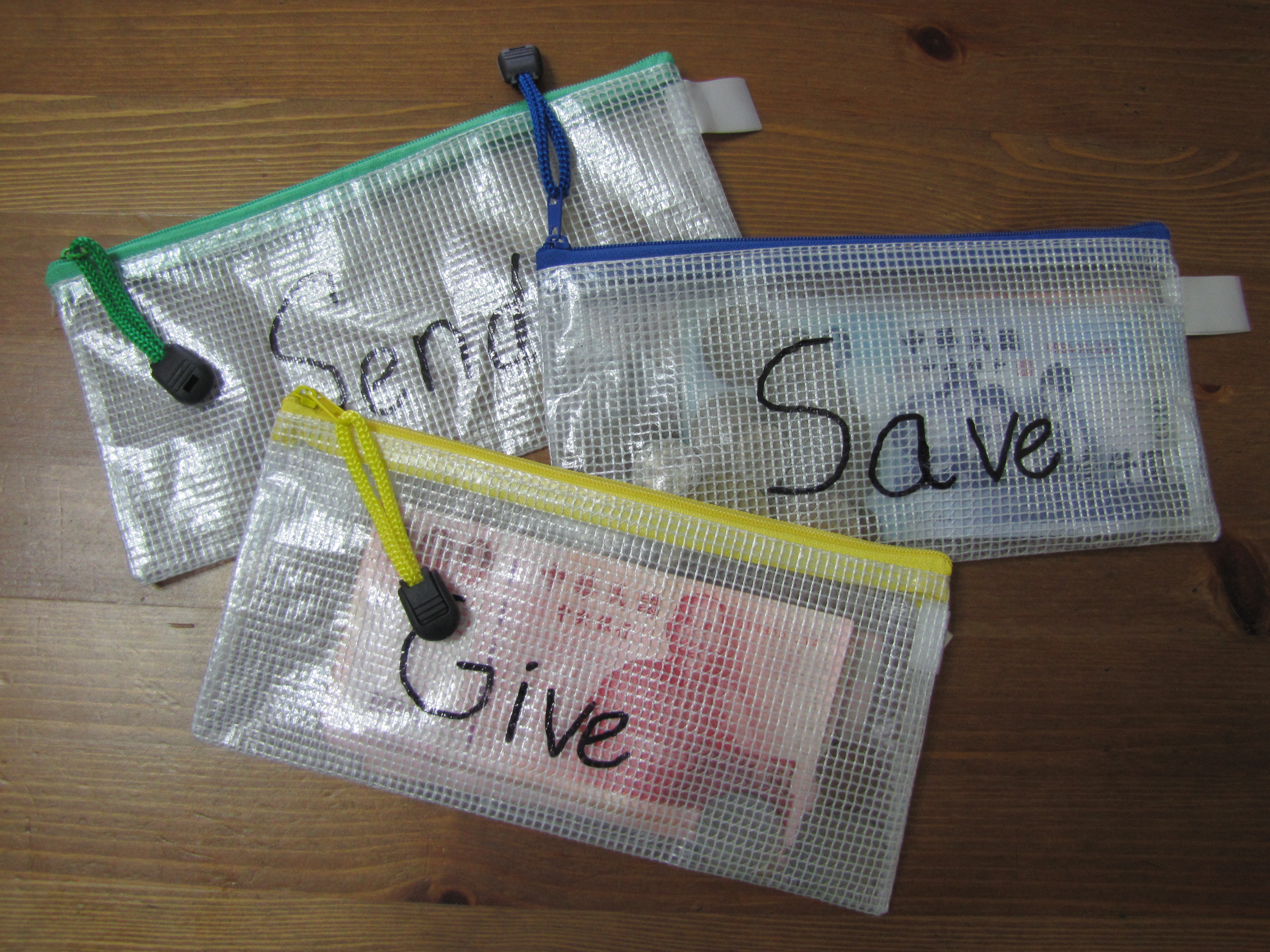
Each child has three envelopes.

  1. Saving: this is for large items that they need to save money for like skateboards, iTouch, dolls
  2. Spending: this is for the small fun stuff like gum, drinks, or stickers.
  3. Giving: Because we are a Christian family, we’ve taught our children that they have to give at least 10% to God. This envelope can also be for charity giving, which we’ve told our kids that they can put in more and use it towards that as well.
Our rules are simple. We give them the money and a calculator. We teach them how to figure out how much is 10%. They put that in their Giving envelope. Then they decide how much they want to put into the Savings and the Spending envelopes. We let them choose.
*We do this system all with the monetary bills of whatever country we are living in. If they get money from family in other countries, then we get out a calculator and figure the conversion rate with them, and then we exchange it for them. After that, they figure out what amount goes in each envelope.
**When we travel to other countries, we do allow them to take their Spending envelope (if it’s worth the amount). They can exchange it at the airport for fun.
***We also do this system with Jie Jie, our daughter with special needs. She doesn’t have a “job” yet, so she doesn’t get paid, but she gets money for lost teeth and birthdays. I do believe that we will soon be giving her a “job” that is suitable to her needs in the near future.  This all depends on maturity levels though.
Like I said, there are other ways to teach kids about money and how to manage it. How have you taught your kids? Please comment below.
If you’d like to read more from raisingmytcks, you can subscribe and new posts will come to your email directly.

“Extreme Schooling”: Article Review

by flickr (The Commons)

If you haven’t had read the NY Times article, “My Family’s Experiment in Extreme Schooling” by Clifford J. Levy, you need to do that now. It is insightful, well written, and will help make sense to the rest of this post.

After I read his article, I felt like he had some really good points for parents who have children attending schools where the family’s first language is not taught.

1. He mentions that his oldest daughter had an inner struggle with not being able to learn the language “effortlessly”. I think as parents we need to remember that though kids do learn languages quicker than adults, it does take effort and time. Also, we need to make sure our children understand this so they do not see themselves as the “dumb foreigner.”

2. Mr. Levy and his wife researched schools online and then had the opportunity to visit the school before enrolling their children. They met the founder of the private school and learned about his philosophy. Most families are not able to actually go to the school beforehand, but research is definitely a possibility now with the internet.

3. Mr. Levy and his wife didn’t force their children to stay in the Russian private school. They gave them the option of leaving and starting at the international school. Interestingly, though, none of the children took them up on this offer. They all stayed in the Russian school and began to survive, then thrive. The Levy’s, I believe, were fortunate to have this option. Not every family has the option of schools available with their first language taught.

4. It seems that the Levy children noticed their own personal academic strengths. They put their energy into those subjects to show some success. The strength was math. I’ve witnessed this when I taught at the international schools. I noticed that the favorite subject of almost every ESL student I had was math. It was the one subject they could really succeed and even be at the top of the class in. As parents, we need to watch for this and encourage our children in their strengths.

So, I’m curious to hear from you. What are your thoughts about this article? If you are sending your child to a school that is not taught in your native language, how have you helped your child(ren) cope? Please share in the comments below.

Global-Minded Children

A couple of weeks ago I read a blog post, Global-Minded Education: A New Currency for the 21st Century, by Libby Stephens. That article has made me stop and ponder what I teach my own children on a daily basis. If you have a moment, go and read it. It is very insightful and thought-provoking as a parent and as an educator, too.

I know and understand that most schools are educating our children in many of the areas that Libby mentions, but what, as parents, can we do to reinforce this global mindset in our children?

1. Educate Yourself. You will not be able to teach, or even talk about any of the issues that Libby writes about if you first do not already know something about it. So grab a newspaper, open up an online news channel and find out what is going on globally. Read articles on environmental living, and brainstorm with the whole family ways to change your lifestyle habits for the better. If you haven’t read Libby’s blog post, go now. That’s a good starting point.

2. Talk with your child(ren). Some of the issues are not for the younger crowd, so if you have young children pick the ones that are appropriate. If you have older teens, find out what they already know and begin the discussion. Talk to your child(ren) and discover what issues really concern them. Are they concerned? Can we challenge our child(ren)to think about other things other then their homework, their friends, their iphones, etc.? I think so. Make one night of the month Discussion Night and talk about one of the issues.

3. Make a Plan. I think talking is good and it helps to educate the whole family, but is there anything that you or your child(ren) can do? Does your child want to actively do something? I was challenged this summer by the story of Rachel Beckwith, the 9-year old girl from Washington state that asked her friends and family to donate money to Charity Water instead of buying presents. Her goal was $300, but she didn’t quite make it by her birthday. A few weeks later, she died in a car wreck. Her death challenged people from around the world to give in her honor. The total amount given was around $1 million. A 9-year old. Astounding isn’t it? What really stood out to me about Rachel, though, was her desire to help others, her global mindset.  At age 5, she grew her hair out for Locks of Love, an organization that uses hair to make wigs for people who have cancer or other diseases. Where did she hear about this organization? How did she come up with this idea? I don’t have those answers, but I applaud her parents for encouraging and allowing her to do those things. Her parents are an example to me. How am I equipping/encouraging my children to do those kind of things? It all goes back to #1 and #2. Inform yourself, talk with your kids about those issues, and then listen to see what your kids want to do about them.

What are your thoughts? Are you challenged by Libby’s post? What are your ideas? Please comment below.

*If you’d like to read more about Rachel Beckwith, Nicholas D. Kristof wrote an excellent piece, Rachel’s Last Fund-Raiser, for the NY Times.

The Days After the First Day of School

Last post I shared tips on how we were going to help our youngest make the transition into a new school. Her first day went well.  She made friends. She liked her teachers. A week has gone by and all seems okay, yet she isn’t completely confident. She’s excited about school, but also nervous. At first I was concerned, but my wise husband reminded me that we just need to give her time to adjust.

Maybe, like me, you are concerned about your TCK and how they are adjusting to their new school.  Give. It. Time.  Whether transferring from a new country or from a local school, he is in a period of transition. It may take a few days, a few weeks, maybe even a month for him to find his place and feel secure. This all depends, of course, on his age. How can parents help?

1. Listen, Listen, Listen.  This is probably the most important, yet hardest to do. We all want to “fix” the problems immediately for our hurting/struggling child(ren), but many times we just need to listen.  Listening to a 6-year old vs. a 16-year old is not the same and should be approached differently.  Younger children can be asked questions like, What was the best part of today? the worst? Who did you play with at recess? Older children will shut off immediately if you start asking questions like that. They may even brush off the question, How was your day?  I’ve found that I’ve learned more from my oldest child when I am not trying to pry information from him.  This usually happens when we are playing a game, putting a puzzle together, or doing the dishes together. Really, it can be anything that doesn’t make him feel like he’s under interrogation. Find time to do something with your older child, but the key is when they do start to open up and share, you need to listen.

2. Encourage your child to get involved. What is your child interested in?  Check to see if your school offers activities or clubs after school, then encourage your child to get involved with one. If there are no clubs at your school ask if you could start one. Being involved in school activities helps develop friendships and forms a feeling of belonging. Both necessary for the transition to a new school.

3. Talk with your child’s teacher. If after a few months have past and you still notice that your child isn’t transitioning well, then make an appointment to see the teacher. Ask his teacher if he has noticed anything during the school day. If there is a concern, then a counselor might need to be consulted.  If the teacher hasn’t noticed, then ask him to observe that week to see what your child does at recess or during free time. It might be that all is fine at school, but at home he is reminded of what he left behind.  In that case, he is still in transition, which is normal.

How have you helped your child(ren) transition after that first day?  Love to hear your ideas!

Parent’s Guide to First Day of a New School

I posted last time that our youngest will be attending a new school in a few days.  I shared some ideas about how we have prepared her for her new school.  Now what about that first day? How can we, the parents, make the start as smooth as possible for our child(ren)?  Below are 5 ideas that I think will help you (and me, too!).

1. Talk to your child(ren) about the first day.  Does your child want to be taken to the classroom or just to the front door?  A younger child will probably want to be taken to the classroom. An older child may prefer you be out of sight that first day and most likely everyday! Talk to your child and make a plan, but be prepared for a quick change of mind that morning. First day fears could take over.
2. Do a practice run. One weekday before school starts you should calculate how much time it takes to get to school in the morning. Leave your home about the time you think you will be leaving to see how long it actually takes. This way you don’t run the risk of arriving late on the first day because you did not consider morning traffic.
3. Plan to celebrate.Kids love to celebrate, so why not celebrate the first day at the new school? It may help your child(ren)  knowing that later on they will get a special treat. It could be dinner that evening at their favorite restaurant or a trip to the ice-cream store right after school.  If it’s not possible to celebrate that first night, plan something for the weekend. If your family is really into celebrating, do both. =)

4. Prepare a little surprise for lunch or snack.  Write a note on a post-it simply saying, “We love you!” or “Hope you are having a great day!”  You could also wrap their favorite snack up like a present.  Here’s what Jamie Oliver (!) suggests: carve a message into the banana peel. The words become darker with time.  Anything to bring a little smile to their face!

5. Don’t stay too long. What I mean by this is, don’t stay in or near the classroom very long. I know some kids will cry and cling, but the best thing is for the parent to kiss the child, tell them they love him/her and will be back after school, and then walk out.  Leave. Don’t stand in the hallway or anywhere your child can see you. This will only upset your child more. Usually, after about 15 minutes or so, they will become engaged in an activity and the tears will stop. If you are worried, you can always go to a nearby coffee shop with some friends.  The school has your phone number, so if there is a real problem they will call you.

Okay, your turn. Do you have any other ideas? I’d love to read them. Please share in the comments below.

*photo by flickr

Back to School…only it’s a new school.

It’s that time of year again.

I have started to think about school supplies…like trying to locate the backpacks, lunch bags and anything else that my kids will need on their first day of school.

Yes, school starts in less than a week for two of my kids. For my youngest, this will be a new school. She attended a local school for the past few years, but will now attend the “American” school where we live. She’s a bit nervous and excited all at the same time. She’s been asking questions about her class, her teacher, and if she will have to take her shoes off before entering the classroom.

I believe as parents we must help our kids transition into a new school.  Whether it is changing schools because of a new city/country, going from local school to international school, home-school to a classroom setting, we need to help them feel more confident. I’ve listed 5 ways that you could help your child with this transition.

1. Tell your child what language will be spoken at the school. This sounds very simple, but younger children (and maybe even some older ones) may not realize this and are either pleasantly surprised because they do  understand OR worse, shocked and scared because they don’t understand.

2. Tour the school.  If you can, call in advance and set up a tour.  Or, if this not possible, look up the website of the school and see if they have any video tours or pictures to show what the campus looks like. Show your TCK the classroom, the playground, the cafeteria and anything else that would be of interest to your child(ren).

3. Meet the teacher(s). If possible, try to meet the teacher. Don’t stay too long because they are busy, especially the week before school starts getting the room ready. Most teachers are happy to meet new students briefly before the semester starts. Older students may or may not want to do this. I’d go with whatever they decide. If you are not able to meet the teacher, then check online and see if the school has photos of the faculty. Then at least you and your child will see what your teacher looks like.

4. Meet classmates.  This one might be tough to do, but it’s not impossible. Ask your school if they would be willing to give you contact information of other parents. Also, go to English language churches, clubs, or restaurants that you think other members of the expat community might attend.  In addition, there maybe various websites regarding expat life in your city. Check those to see if there are any events for children.

5. Listen to your child. This is the most important. Let them share their fears, excitement, and sadness with you. They will most likely be sad about leaving the “old” school.  You may just need to hold them and let them cry. It can be a hard “season” for everyone, but it is just that, a season. It will change and it will get better. Share that you understand and are there for them.

I understand that my daughter might still be nervous and may even shed a tear come Monday morning. But, at least I know some of her fears can be put aside because of taking these steps.

I know there are other ideas out there. So share. What have you done to help your child transition into a new school?