Mamas Need Their Outlets, too!

Golfers on the Coral Gables Country Club

photo from The Commons via flickr.com

Schools are starting back up for many around the world. For some families that means getting routines set, taking one last holiday, but for many others it is setting up the new home and getting the kids excited to start a new school – or at least helping them to adjust to a new school.

Women's Curling Briar

photo from The Commons via flickr.com

What happens on that first day though, once all the kids are dropped off at school and you return to a quiet home? Do you collapse in wonderment? Do you get a fresh cup of coffee to slowly savor without distractions? Housework? Chores? Cry?

What do you do? You need an outlet, too! A place where you can laugh with friends, discuss or chat. You just need a place where you can be you, the person – not the mom. Don’t get me wrong, I love being Mom. It’s just that once in awhile it is nice to have adult conversations and to eat at my own pace my very own dessert.

What do these “places” or groups look like? Some cities have regular set dates that an expat group has organized. Other cities may not have anything set, but maybe the school has a Mother’s Tea where you can meet other moms. This group could be a Bible-study, book club, or any other small group gathering that meets for a certain purpose.

Why should you get involved in a group? Women in general support each other and talk – as Apple Gidley in her book Expat Life Slice by Slice says, “…international women groups around the world, whether a luncheon group, a tennis club or a sewing group are expatriate man’s best ally” (p40). I so agree with her on this because who understands our situations better than another expat mom? We become fast “sisters” helping and encouraging each other.

How do you find these precious gems? You have to look for them. Ask other mothers at the school what there is to do. Find out if your city has an expat magazine or website that lists activities that would interest you. If there isn’t, you could start one. I’m sure there are others out there who would love to go out for coffee, too!

I’ll leave you with this last tip from Apple in finding a group: Make sure it is international, not made up from solely one country. She says that, “Instead of celebrating the differences they {mono-culture groups} tend to moan about them, whereas international groups are more forgiving” (42).

So, go out and find a group and make some friends of your own. Already in a group? Watch for the new moms and invite them to join – be a bridge to help them settle into their new home quicker.

*Although this is geared towards the mother as the trailing spouse, there are groups out there for dads/guys as well, but I find that guys don’t tend to “need” this close bonding friendship like women do.

**Thanks to Janneke at DrieCulturen for giving away the book Expat Life Slice by Slice by Apple Gidley.

Related articles

Enhanced by Zemanta

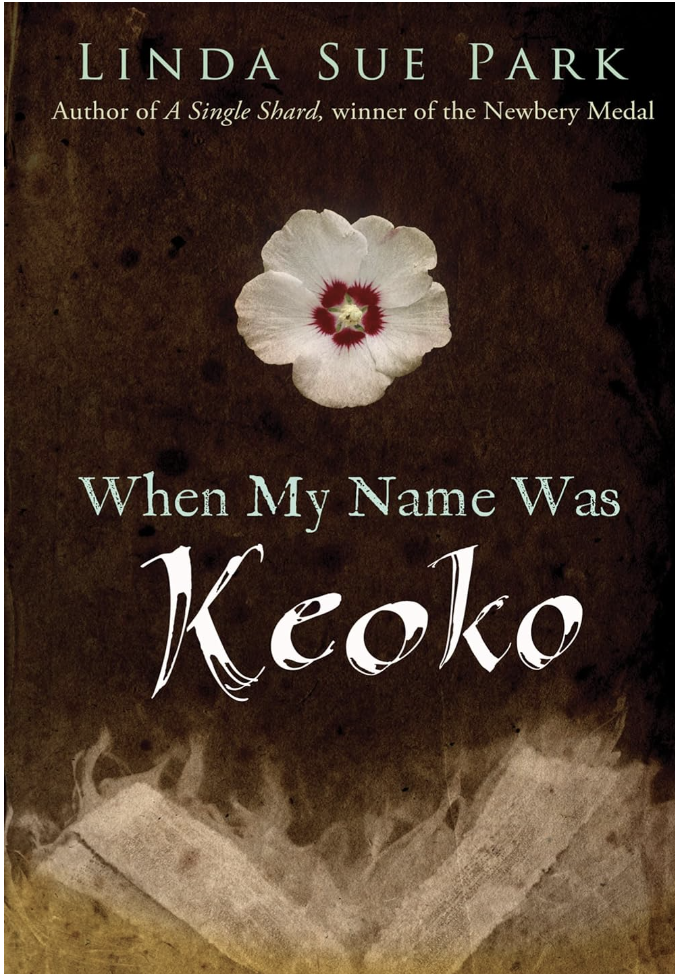
Book Review: WHEN MY NAME WAS KEOKO by Linda Sue Park

When My Name was Keoko

by Linda Sue Park.

Published: 2012

Genre:Middle School Historical Fiction

*Please note as an Amazon Associate, I earn from qualifying purchases.

Screenshot 2023-11-23 at 8.52.44 AM

WWII did not just affect Western countries, but it also affected Asia as well. Linda Sue Park shares an Asian point of view through her gift of storytelling. We watch the events of WWII unfold around Sun-yee and Tai-yul, a Korean sister and brother. 

As the term “Third Culture Kid” expands to “Cross-Cultural Kid,” I believe this book represents some broader aspects. 

  1. The characters are CCKs: The children at this time were more like CCKs, or “domestic TCKs” in their own home country. The Japanese occupied Korea. They tried to replace the Korean culture with Japanese culture. One way was by changing everyone’s names to Japanese names. So, Sun-yee became Keoko, and Tai-yul became Nobuo. Throughout the story, the family struggles to hang onto their Korean culture by trying to teach the children what it means to be Korean.
  2. Language is essential: Korean was forbidden during this time. All classes were conducted in Japanese. No one was to speak or write in Korean. Because of this, the Korean language was almost lost. Sun-yee’s father saw the relationship between culture and language, so he secretly taught her the Korean alphabet. For many non-English speaking families, the language struggle to ensure the children do not forget their “mother tongue” is real.
  3. To see the human being: I mean not being judgmental towards other nationalities. Before the Japanese came, Sun-yee’s good friend was the Japanese neighbor boy. As tension builds against the Japanese, Sun-yee becomes confused by what the Koreans say about the Japanese. Her friend is not like those descriptions. When she is older, she does become friends with the Korean girls, but she never has harsh feelings about her neighbor. They help each other out at different times. TCKs/CCKs have the opportunity because of the international schools/communities to see past prejudice and see the person for who they are, not the country their passport says they are from.

Thoughts about a TCK kind of book…

I just finished reading Listening for Lions by Gloria Whelan and did a full review at The Fill in the Gaps site. You can click here to read more on it.

Rachel is a TCK living in Africa with her missionary parents. She loses them and must say good-bye to all the she knows and moves to England.

I think this would be a good book for a TCK to read because I really believe they would understand the feelings that Rachel has as she is trying to transition into the British way of life. Something that is part of her parent’s culture, but not completely her own. The ending I’m not totally agreeing with, but it could happen, just not always likely.

It was a perfect book for me to read right before our “return” trip to the US to visit family.  I was reminded that what I consider “normal”, they may see as strange or not get it.

Your Turn: Have you read this book or another fiction book that had a TCK as the main character? Please comment below.

Enhanced by Zemanta

Book Review: “Home Keeps Moving” by Heidi Sand-Hart

by Heidi Sand-Hart

Summary: Heidi shares her life as a TCK/MK from India moving from country to country from continent to continent, and from culture to culture. She shares the joys, the excitement, and the hard ugly truth of the pain from her experiences. She uses many quotes from other TCK related books and then shares stories as examples. Some stories are her own, others are from fellow TCKs who have written about their own experiences. She discusses issues such as loss, grief, education, and “rootlessness”.

My thoughts: Loved it! I checked it out from the library and had a hard time not writing in it – so I am ordering my own copy soon. It’s not a “how to” book that gives tricks and secrets to making a TCK’s life work out perfect. Instead, Heidi gives the reader a glimpse of her journey in life. It gave me some insights to not only my children, but to my husband as well. She tackles some pretty tough subjects and I like that she doesn’t give a recipe on how to approach the difficult times. She reminded me that each TCK is different, so therefore the process for each is going to be different as well.

If you are a TCK and haven’t read this, I encourage you to check it out. It just might give you the courage to continue to seek out some unresolved issues in your life.

If you are a parent to a TCK – I recommend it just to be able to hear views from a TCK who is open and honest. You just might be get a few insights of your own.

You can get the book here at Amazon. Or if you want possible free shipping click here at Book Despository.

Your Turn: Have you read the book? What were your thoughts?

Enhanced by Zemanta