KID$: Teaching them about $

The Envelope System

Ever since my TCKs were cuddled into the front pouch and brought to the market or store, they have witnessed how money can give them “stuff”. They understood all too quickly how this system of money or plastic card works.

I’m sure your kids are the same. They don’t just watch us. Toy manufacturers have caught on to this years ago. They sell fake money and plastic cards for pretend shopping. I’m not bashing toy companies, I actually think it is a brilliant way to teach kids about how money works IF taught intentionally.

As kids grow and mature, we need to teach them how to manage their money.

We do give our kids an allowance…sort of. They get paid for certain small jobs around the house like taking out the trash. They get paid for the work they do. If they don’t take out the trash, they don’t get paid. Then there are jobs that they have to do just because they are part of the family, like setting and clearing the table. Those they don’t get paid for.

Our youngest got bright eyes and a huge smile when she got her first paycheck. She was ready to go to 7-11 and buy some gum. It reminded me the first time our oldest got his first paycheck and we made the decision to teach our children about money management. It was time to teach Mei Mei.

We use Dave Ramsey‘s ideas because we like them. I’m sure there are other ways to teach your children, but here is what we do.

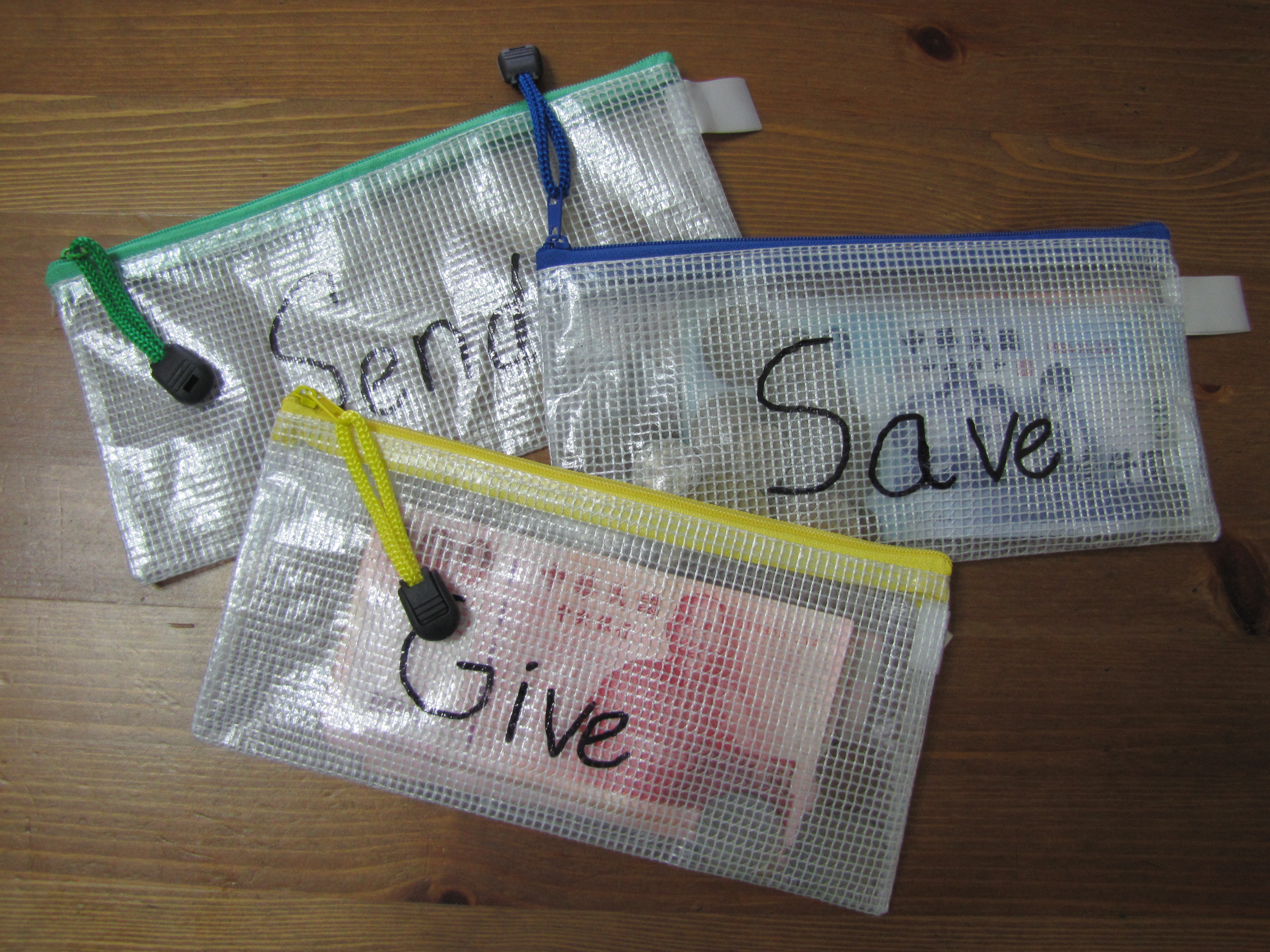
Each child has three envelopes.

  1. Saving: this is for large items that they need to save money for like skateboards, iTouch, dolls
  2. Spending: this is for the small fun stuff like gum, drinks, or stickers.
  3. Giving: Because we are a Christian family, we’ve taught our children that they have to give at least 10% to God. This envelope can also be for charity giving, which we’ve told our kids that they can put in more and use it towards that as well.
Our rules are simple. We give them the money and a calculator. We teach them how to figure out how much is 10%. They put that in their Giving envelope. Then they decide how much they want to put into the Savings and the Spending envelopes. We let them choose.
*We do this system all with the monetary bills of whatever country we are living in. If they get money from family in other countries, then we get out a calculator and figure the conversion rate with them, and then we exchange it for them. After that, they figure out what amount goes in each envelope.
**When we travel to other countries, we do allow them to take their Spending envelope (if it’s worth the amount). They can exchange it at the airport for fun.
***We also do this system with Jie Jie, our daughter with special needs. She doesn’t have a “job” yet, so she doesn’t get paid, but she gets money for lost teeth and birthdays. I do believe that we will soon be giving her a “job” that is suitable to her needs in the near future.  This all depends on maturity levels though.
Like I said, there are other ways to teach kids about money and how to manage it. How have you taught your kids? Please comment below.
If you’d like to read more from raisingmytcks, you can subscribe and new posts will come to your email directly.

Wishing you a Good Week

Here’s hoping that your week starts out better than mine did last week.

Yep, that is Nutella (think chocolate hazelnut spread) splattered on my floor with handprints.

Jie Jie’s hand-prints. If you want to read about the whole story click here. I posted about it on my personal blog.

If your week gives you some “splatters”, grab a camera and take a picture. You really will be laughing a few hours after you clean it up. And in those few moments of getting the camera and taking the pictures, you will have calmed down enough to respond to the situation instead of reacting in anger.

Simple Pleasures

Raising TCKs can be fun and adventurous.
Heck raising kids can be fun and adventurous.
With all the fun and adventure though, I get tired and a bit weary. I’m feeling that today.
The weather is NOT helping either.
So, what to do?

Enjoy some simple pleasures.

You know those very simple things in life that just bring a smile to your face? A specific candle scent. 5 minutes with a magazine or ezine. 5 minutes of uninterrupted time of quiet.

My simple pleasure?
Coffee with a sprinkle of cinnamon. My trick is to put the cinnamon in with the coffee grounds. My body begins to relax just from smelling the coffee brew. And the taste? Well, a little taste of wonderful.

And today I’m having that with a piece of pumpkin pie. Pie that I didn’t even bake. It was from a friend who gave it to us. Just another simple pleasure.

What is your simple pleasure? How do you survive those dreary days? Comment below.

Vacation Turned Staycation

If you remember I posted awhile back our plans to go camping over vacation. Well, that didn’t happen. We decided to take the tips that I wrote about and do a staycation. If you did not get to read those tips you can click here to read them or review them.

I’ll admit I had mixed emotions. I wanted to get out of the city, away from the apartment, to escape the routine, but the thought of packing everyone up and camping was a bit exhausting. The weather wasn’t looking that great either, so Leaky Tent Phobia took over. We stayed home.

What did we do?

1. Celebrated 100 years of ROC.  We stood with the other few thousand gathered around the intersection to watch the military drive by. I would call it a parade, but it wasn’t really one. The real parade was invitation only. We caught the line up after the show on their way back to base. It was still pretty spectacular with the face paint, fighter jets flying by, and the parachuters jumping out with their red, blue, and white parachutes.

Frog Men armed and ready...

This guy scared me and intrigued me all at the same time!

"The French have landed! The French have landed!" was what my husband wanted to shout as they glided down to the ground. =)

Watched the show from our rooftop!

2. Beach Trip. Went to the beach for half a day. We forgot the boogie boards, but kids caught some waves anyway. Any day at the beach is a good day, sand and all.

3. Cable Car Ride. We rode the cable car up to the tea farms. Our cable car had a glass bottom. Yes, it did! To say the least, it made for an interesting ride as we climbed higher and higher up the mountain. I wasn’t sure if it was really that hot inside our glass death trap or if my body was reacting to the little bit of stress I felt every time Jie Jie would get excited and start jumping. We survived the 30-minutes and took the glass bottom box back down. All for the love of our kids, cause it ain’t gonna happen again!

4. Zoo Trip. A few hours with friends at the zoo is always fun. I officially called our group, The Crazy Mom Club. You know 5 moms take out 14 children. No more needs to be said, except that we didn’t loose any kids and we all were laughing and having fun.

I’m really glad we didn’t go camping. We would have missed the “parade”, the fireworks, and probably would have had to sleep in the rain. It was the best decision we could have made. Bonus points: we saved money. Now I’m planning Christmas vacation with more money in our budget.

If you had a fall break, what did you do? What other staycation ideas do you have? Share in the comments below.

Overseas Halloween Dilemma (or maybe it’s not)

Jack-o'-lantern

Jack-o’-lantern by wwarby’s photostream via flickr

October is here and Halloween is only a few weeks away.  This holiday is typically a LOVE or HATE type of holiday. People either love it and go all out with hanging skeletons and witches all over the yard, while others not so much and don’t participate in any of the activities. Instead, they may decorate with fall leaves, happy cute jack-o’-lanterns, and Indian corn. Whichever side you are on (or what country you are in), with children you have to plan ahead.

Living overseas doesn’t mean that all holidays must be done away with, but it will take some planning to make them happen. Here are some ideas to plan for Halloween. (for those that don’t celebrate, scroll down for ideas on that)

1. Decorations, Candy Corn, and Costumes. It is possible that you can find some of these things in the city/country you live in, but maybe not. This is where planning ahead helps. Have those grandparents, aunts and uncles mail some of this stuff to you. Kids LOVE care packages, and I’m sure you don’t mind them either. =) As for costumes, you might just make your own or have a local tailor make something for you.

2. Trick or Treat. Assume that this holiday is not celebrated in the country you are living in, but don’t assume that no one celebrates. Check and see if any of the expat hangouts are holding a Halloween party for kids. If they are not, why not get with a few other parents and plan a simple one?   *Note that if there is a party, you might want to check the age appropriateness of the party just so you don’t scare your toddler to tears and don’t bore your teen to the point of no return.

If you live in the Paris area, I do know that Disneyland Paris is celebrating Halloween Mickey style. You can get more details about that at this blog post by Selenapan9, an expat mom. If you are heading to Hong Kong Disneyland or Tokyo Disney Resort, then you might want to check out what they are planning.

My family doesn’t celebrate Halloween, but we still plan ahead for it. We decorate for fall, which is sort of hard to do when you live in a more tropical setting. But, here is a list of our traditions that we do during the fall season.

1. Fall Tree. We create a fall scene on a wall. Sometimes this wall is inside the apartment, other times it is by our door. We use large brown butcher paper to make the tree. Then I let the kids cut out leaves from fall colored construction paper to hang up on the tree and on the ground. Later, I let the kids cut out paper pumpkins and they taped them up under the tree.

2. Scarecrow. We make a scarecrow together. Living in the city we don’t have straw, so we use newspaper to stuff the overalls and shirt. Last year we placed him outside our door for a few days, and then had to bring him inside. He scared our neighbor girl, so be aware of your neighbors. 😉

3. Pumpkin carving. Last year we were able to find pumpkins, so we made it a family project and carved them together. The kids LOVED this!

4. Watch It’s the Great Pumpkin, Charlie Brown! together. I keep this DVD put away until October, and then we watch it together to celebrate the changing of the season. If we get a fall care package we’ll pull out the goodies, too.

5. Talk to our kids. If you choose to not celebrate a holiday, I believe you need to inform your children about the holiday and why you, as a family, don’t celebrate. We explained this to our kids when they were old enough to understand it all. I’m sure we’ll have some questions again this year, as our youngest is only 6.

Our kids start their fall break tomorrow. Guess I need to pull out some of our decorations and that DVD out tonight. They’ll be excited to get started.

Does your family celebrate Halloween? How do you celebrate? If you don’t what are some of your fall traditions? Please leave a comment below.

Hospital Tips

A few weeks ago I posted on tips for seeing doctors and dentists. My middle child was admitted into the hospital with pneumonia last week. Unfortunately, this is not the first time for her. But, as we spent our days and nights at the hospital I thought I’d share what I pack when we’ve had an overnight stay (or two, or three, or…) at the hospital.

1. Clothes/toiletries. Extra clothes for me and for her. The basics of toiletries. I went home for showers. I should have packed a sweatshirt because it was freezing in our room, but a good friend brought me one.

2. Bible and BSF material: I’m a Christian, so reading the Bible is important to me. I also just started Bible Study Fellowship, so I wanted to keep up on the study material. =)

3. Computer/cell phone: The hospital has free wifi, so having the computer helped me to stay in touch with the world. Also, I was able to do some writing while she was sleeping.

4. iPad/iTouch: We were blessed with an iPad last spring, so this provided some major entertainment. Jie Jie wasn’t allowed to go out and about, so having this was great. We had some educational apps and videos that she could play on and watch.

5. Books. I brought books to read to her. I also brought a book for myself.

6. Snacks: She wasn’t too hungry, so I didn’t have that much for her. I mainly brought some seeds and nuts for me to snack on during the times I was there by myself. We did have a little refrigerator in the room that we shared, so we put in some yogurt drinks for her and some green tea for me.

7. Stuffed animal: We couldn’t bring her favorite because right now that is a giant sized dog, but we did bring the next best thing, her giraffe. A friend did bring her a fairly large monkey that she loved on as well.

This was pretty much what I packed into a small suitcase. We ended up only being there for two nights, which I’m thankful for.

How about you? What have you taken to the hospital to entertain your child or yourself? Any other thoughts that would help make that overnight stay smooth? Share in the comments.

“Extreme Schooling”: Article Review

by flickr (The Commons)

If you haven’t had read the NY Times article, “My Family’s Experiment in Extreme Schooling” by Clifford J. Levy, you need to do that now. It is insightful, well written, and will help make sense to the rest of this post.

After I read his article, I felt like he had some really good points for parents who have children attending schools where the family’s first language is not taught.

1. He mentions that his oldest daughter had an inner struggle with not being able to learn the language “effortlessly”. I think as parents we need to remember that though kids do learn languages quicker than adults, it does take effort and time. Also, we need to make sure our children understand this so they do not see themselves as the “dumb foreigner.”

2. Mr. Levy and his wife researched schools online and then had the opportunity to visit the school before enrolling their children. They met the founder of the private school and learned about his philosophy. Most families are not able to actually go to the school beforehand, but research is definitely a possibility now with the internet.

3. Mr. Levy and his wife didn’t force their children to stay in the Russian private school. They gave them the option of leaving and starting at the international school. Interestingly, though, none of the children took them up on this offer. They all stayed in the Russian school and began to survive, then thrive. The Levy’s, I believe, were fortunate to have this option. Not every family has the option of schools available with their first language taught.

4. It seems that the Levy children noticed their own personal academic strengths. They put their energy into those subjects to show some success. The strength was math. I’ve witnessed this when I taught at the international schools. I noticed that the favorite subject of almost every ESL student I had was math. It was the one subject they could really succeed and even be at the top of the class in. As parents, we need to watch for this and encourage our children in their strengths.

So, I’m curious to hear from you. What are your thoughts about this article? If you are sending your child to a school that is not taught in your native language, how have you helped your child(ren) cope? Please share in the comments below.

TCK Checklist, Plus Some Resources

list by Cathdewlist, a photo by Cathdew on Flickr.

This post today is just to let you know of a great website and resource.  Last post I responded to Libby Stephens‘ article on TCKs. She really is one of the top experts on TCKs, so if you have TCK questions go to her website. She travels a fair amount to speak at schools and communities all over the world. If she is in your city and offering a seminar. GO!

This week she posted about characteristics of a young TCK. Go here to read what she posted about this topic. You’ll learn something I’m sure!

She also has a whole page full of resources. I use this page quite a bit and am so thankful that she has put it together! Makes it easier to research and get answers to questions I have.

Global-Minded Children

A couple of weeks ago I read a blog post, Global-Minded Education: A New Currency for the 21st Century, by Libby Stephens. That article has made me stop and ponder what I teach my own children on a daily basis. If you have a moment, go and read it. It is very insightful and thought-provoking as a parent and as an educator, too.

I know and understand that most schools are educating our children in many of the areas that Libby mentions, but what, as parents, can we do to reinforce this global mindset in our children?

1. Educate Yourself. You will not be able to teach, or even talk about any of the issues that Libby writes about if you first do not already know something about it. So grab a newspaper, open up an online news channel and find out what is going on globally. Read articles on environmental living, and brainstorm with the whole family ways to change your lifestyle habits for the better. If you haven’t read Libby’s blog post, go now. That’s a good starting point.

2. Talk with your child(ren). Some of the issues are not for the younger crowd, so if you have young children pick the ones that are appropriate. If you have older teens, find out what they already know and begin the discussion. Talk to your child(ren) and discover what issues really concern them. Are they concerned? Can we challenge our child(ren)to think about other things other then their homework, their friends, their iphones, etc.? I think so. Make one night of the month Discussion Night and talk about one of the issues.

3. Make a Plan. I think talking is good and it helps to educate the whole family, but is there anything that you or your child(ren) can do? Does your child want to actively do something? I was challenged this summer by the story of Rachel Beckwith, the 9-year old girl from Washington state that asked her friends and family to donate money to Charity Water instead of buying presents. Her goal was $300, but she didn’t quite make it by her birthday. A few weeks later, she died in a car wreck. Her death challenged people from around the world to give in her honor. The total amount given was around $1 million. A 9-year old. Astounding isn’t it? What really stood out to me about Rachel, though, was her desire to help others, her global mindset.  At age 5, she grew her hair out for Locks of Love, an organization that uses hair to make wigs for people who have cancer or other diseases. Where did she hear about this organization? How did she come up with this idea? I don’t have those answers, but I applaud her parents for encouraging and allowing her to do those things. Her parents are an example to me. How am I equipping/encouraging my children to do those kind of things? It all goes back to #1 and #2. Inform yourself, talk with your kids about those issues, and then listen to see what your kids want to do about them.

What are your thoughts? Are you challenged by Libby’s post? What are your ideas? Please comment below.

*If you’d like to read more about Rachel Beckwith, Nicholas D. Kristof wrote an excellent piece, Rachel’s Last Fund-Raiser, for the NY Times.

Children and Crowds

It’s night and the clouds have created a dark night. Not a single star is in view. Then one peaks out from behind the clouds shining brightly. It stands out and you can’t help but gaze at it. That description is kind of like living in Asia (or any other country that the population mainly looks the same), but not being Asian. You stick out. People gaze at you. You are different than the majority. When a child enters the scene, all eyes turn towards the mini-version of you. That mini-version is like a comet on a clear night with lots of stars out, People don’t just gaze at it, but also marvel and point at it.

Some kids take the spotlight and perform like an actor on broadway. They dance and jump, and maybe even speak to the crowd of onlookers. Other children freeze up when the spotlight glares at them. They may cry or scream for their dad or mom. I don’t believe being born in a different country has to do with whether the child loves crowds or not. My three children were all born in Asia, yet they all respond in very different ways. One is the star, one hides, and the other is a mixture of the two. I do believe that age can play a factor, but not always. I’ve watched my child who hides behind me whenever approached begin to not do that. Instead that child will now say, Hi, and answer simple questions.

As parents, we want to protect our children, yet teach them respect. Here are a few strategies that I took with the kids were younger.

1. Grab and Run. Not literally, but the idea of taking the child quickly out of the situation.  It is the times when your child(ren) are in danger or exasperated to the point of super meltdown. Young children need to feel safe and that you are going to protect them. If they are in extreme fear, this needs to happen.

2. Hide and Smile. Similar to the above, except that your child is not in danger or extremely afraid, just upset. Picking up the child and letting them hide their face gives them some space and a sense of protection. A smile from you, and maybe simply saying He/She is really shy, will let the crowd know that everything is ok.

3. Watch Them Shine. This is when your child is loving all the questions and the attention. Stand nearby and watch them entertain. Maybe they will become an actress on stage and this is their first audience!

Now that my kids are older, I expect them to be respectful of others. They are old enough to greet properly and answer simple questions. If they don’t feel like speaking, I tell them that they at least have to say Hi with a smile, and then they can walk away. I don’t expect them to perform like monkeys on stage. They know this, but they also know that I expect them to not be rude.

How do you handle these situations? How have you taught your child(ren) to respect others when they don’t want to be on “stage”?

*photo by flickr