The US Dialect Quiz and TCKs

Maybe you’ve seen the US Dialect Quiz roaming around on Facebook. The quiz is from NY Times and questions are based from the Harvard Dialect Quiz. Basically, you answer twenty-five questions about how you would say certain words or which word you would call an object. Then based on your answers a map is shown where in the US your dialect comes from.

Any expat parent that is not a citizen of the US can probably say that their child has “lost” some of their accent. I know this to be true because my German husband has an American accent. As a teacher I have seen students from other countries speaking with an “American accent,” this includes countries where English is the official language. I vividly remember many years back a little Korean first grader saying good-bye to her teacher in a southern drawl – no hint of a Korean accent. And now, I see it with my Auzzie, South African, and even New Zealand friends – their children have only a hint of their “home” country’s accent.

So, what about an “American” TCK – yes, they most likely will have an “American accent,”but even the US has many varied accents and even vocabulary words. I had two thoughts about this quiz: 1) I wondered if my accent/dialect would be different since I’ve lived overseas for sometime now and 2) if my children would be relatively close to my score. And then the question of just wondering where my husband’s accent/dialect fell since he has an “American accent,” but had only lived there for a total of four years for university (two years on the west coast and two on the east coast).

The results? I scored southern Missouri/northern Arkansas, which I’d call the Ozark region. I grew up in northern Missouri, but went to university in southern Missouri. So, okay I’ll take that.

I had my oldest take the quiz. He scored Washington state.

And my husband? St. Louis, Missouri. Maybe I have had an affect on him after all, or the east and west balanced out? Actually, probably neither.

My thoughts on this? I believe that my son’s language has been affected by his teachers and his classmates just like all other expat children. As I think about it, he has had teachers from Washington state and Canada. And I bet if I asked my husband, his accent would probably be because of teachers and coaches.

I’m not the only one finding this quiz to show a differences between child and parent, though. A friend of mine also discovered the same thing. She scored Texas and Oklahoma, while her son scored North and South Carolina.

So is this breaking news? No, but it may give us another example of why our kids don’t feel “at home” in the place we may call “home.” It is a tiny example, I know, but still an example.

How about you? Have you taken this quiz? Has your children taken the quiz? What were the results? Please share in the comments below.

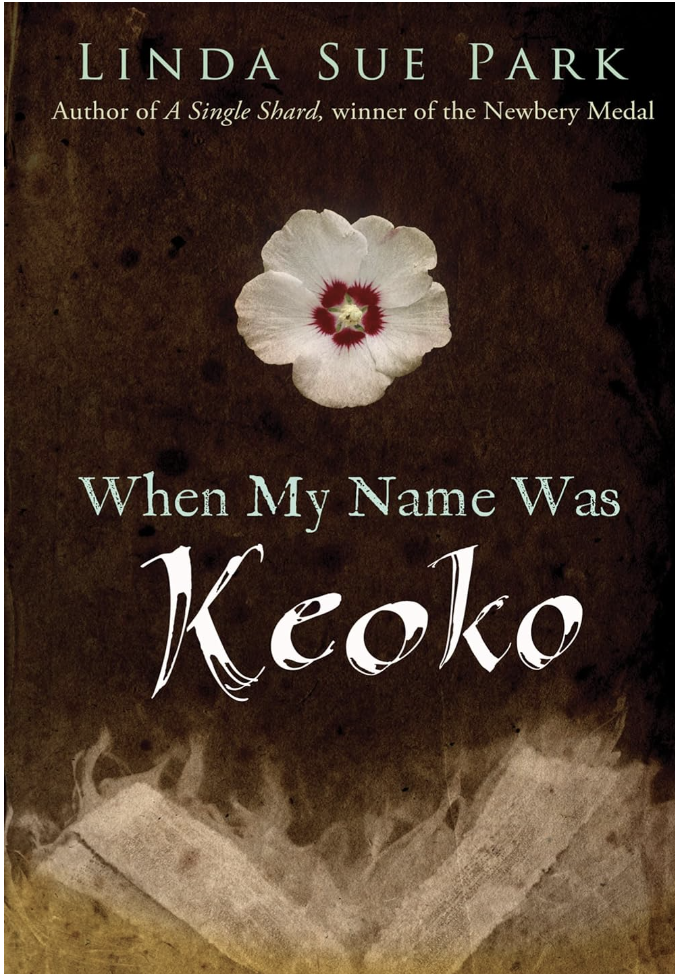
Book Review: WHEN MY NAME WAS KEOKO by Linda Sue Park

When My Name was Keoko

by Linda Sue Park.

Published: 2012

Genre:Middle School Historical Fiction

*Please note as an Amazon Associate, I earn from qualifying purchases.

Screenshot 2023-11-23 at 8.52.44 AM

WWII did not just affect Western countries, but it also affected Asia as well. Linda Sue Park shares an Asian point of view through her gift of storytelling. We watch the events of WWII unfold around Sun-yee and Tai-yul, a Korean sister and brother. 

As the term “Third Culture Kid” expands to “Cross-Cultural Kid,” I believe this book represents some broader aspects. 

  1. The characters are CCKs: The children at this time were more like CCKs, or “domestic TCKs” in their own home country. The Japanese occupied Korea. They tried to replace the Korean culture with Japanese culture. One way was by changing everyone’s names to Japanese names. So, Sun-yee became Keoko, and Tai-yul became Nobuo. Throughout the story, the family struggles to hang onto their Korean culture by trying to teach the children what it means to be Korean.
  2. Language is essential: Korean was forbidden during this time. All classes were conducted in Japanese. No one was to speak or write in Korean. Because of this, the Korean language was almost lost. Sun-yee’s father saw the relationship between culture and language, so he secretly taught her the Korean alphabet. For many non-English speaking families, the language struggle to ensure the children do not forget their “mother tongue” is real.
  3. To see the human being: I mean not being judgmental towards other nationalities. Before the Japanese came, Sun-yee’s good friend was the Japanese neighbor boy. As tension builds against the Japanese, Sun-yee becomes confused by what the Koreans say about the Japanese. Her friend is not like those descriptions. When she is older, she does become friends with the Korean girls, but she never has harsh feelings about her neighbor. They help each other out at different times. TCKs/CCKs have the opportunity because of the international schools/communities to see past prejudice and see the person for who they are, not the country their passport says they are from.

Language and TCKs

“Which language should we speak at home with our children?”

“Which school should we send our children to? Language is important, but I’m afraid my child will forget or not master our ‘mother tongue’.”

As an expat parent, I’ve asked those same questions. As an international elementary teacher, I’ve heard those questions from parents about their own children.

They are legit questions, ones that should be addressed from the get-go when deciding to live abroad with your family. When I was pregnant with our first child my husband, being German, and I decided that I would speak English and he would speak German. Let me just say this, in theory it was a great plan, but for our family it didn’t happen. My husband rarely spoke German anywhere. His working world was in English and Chinese. His world at home with me was in English. He didn’t think about speaking German unless he was talking with his parents, but even that was a mixture of English, German, and a bit of Chinese. Please know that I do know of families that spoke dual languages and it worked wonderfully for them. It just wasn’t for our family. If you have a mixed family, this is definitely something you need to discuss as a family – which language(s) will we speak at home with our kids?

Schooling affects language as well…

Yes, which school do we send our child to? Local? International? Home-school?  These are questions that you definitely need to discuss with your spouse. Something to think about though, is what language do you see your child using as an adult? Is it your mother-tongue? your husband’s? English – if that isn’t your mother-tongue? As an educator, I can’t say this strong enough – Whatever language(s) you decide your child will be educated in make sure your child masters a language – and what I mean is they have mastered both speaking and writing. If your child cannot fully function in one language, they may never be able to fully express their feelings.

Once GeGe was almost pre-school age, Uwe and I discussed what language we wanted him to be educated in. We wanted him to be able to speak Chinese well. We had planned for him to attend local school until Grade 2, with me home-schooling him in English to keep up his writing. We chose this grade level because we knew that he would most likely go to an English speaking university. The English writing begins to expand quickly to paragraphs in grade 3. We didn’t want him to fall too far behind and not master English. Well, this plan didn’t workout for us. He attended only Kindergarten at the local school, then in grade 1 we switched over to the international school, but requested that he be in the same Chinese level as the native speakers in his homeroom. This worked out well for him. Our decision to pull him into the international school was due to the fact that Jie Jie needed to start school and her school was not at the same school. They were not really even close to each other and there was no way for me to get them both to school. GeGe could go in early with my husband, and I could take JieJie.

We speak English in the home, so these questions were not so difficult to answer, but for those expat parents whose language at home is not English this decision must be weighed out carefully. And many times a sacrifice of the mother-tongue happens. The language spoken by the parents is learned, but not fully mastered.

When raising kids abroad, the question about language is huge. It’s one that every expat parent must think through and discuss with their spouse. It is a question that my in-laws had to make over thirty years ago when they decided to send their very young children to the American school versus the German boarding school that was located in a different country. And it will be the question that probably my children will have to make should they choose to live abroad with families of their own.

Your Turn: What language do you speak at home? How did you make the language decision about education? What school do you send your kids to or did your parents send you to? Please share your thoughts in the comments below. I’m really interested.

This post was inspired by a blogpost I recently read about raising kids overseas. She is a TCK herself and understands the advantages and the disadvantages of living abroad. She listed questions one should ask when they begin to think about raising TCKs. The one suggestion that she gives to expat parents is to READ. Read books, articles, and blog posts about and authored by adult TCKs. If you are not currently following DrieCulturen, you should. Great resource!

Related articles

Enhanced by Zemanta

German Logik

Have you ever studied a language and came to a phrase that you just caused you to say, “What”? Or you find yourself giggling over the names that are given to certain items in the other language?  My husband ran across these videos yesterday from a friend on Facebook and they are really funny. A German in the USA….wondering if this is any cause for misunderstandings in our home. 😉

Thought you might like a good laugh to start your weekend off with!

*This has been a catch up week in the apartment, so writing has taken a backseat. I have some fun posts that I’ll share next week on dentists, going away without kids, and more. So keep watch for them!

Hope you have a wonderful weekend!