For many expat families, this is the time of year when decisions are made about leaving the host country for a new posting. Or, in some cases, repatriating to their passport country. In my case, my youngest is in her last year of high school. There are nights when our eyes are glazed over from looking at university applications together, but I am reminded that she also needs to build her RAFT.
What is RAFT?
RAFT is an acronym created by the late Dave Pollock to help teenagers (and adults) in their transitions. It stands for Reconciliation, Affirmation, Farewell, and Think Destination.
It does not guarantee that everything will be smooth sailing, but it gives thought to various aspects of moving and allows the person to process. About this time of year, I usually talk with a group of students in their final year of high school, focusing on building the “F” in RAFT, or Farewell. I challenge them to begin their “[insert host country name]’s Bucket List” now.
So, I am challenging you as a parent who is getting a family ready to move, or if your child is about to launch into adulthood, to start your “Bucket List”.
What Should Go on the “Bucket List”?
If you want to know, please read the Multicultural Kids Blog to read the rest. I was a guest writer for them this week.
By Cate Brubaker, Doreen Cumberford, and Helen Watts
Published 2018
Please note as an Amazon Associate I earn from qualifying purchases.
Book Review:
ARRIVING WELL is a collection of five stories from people who moved to their passport country after an extended time living overseas. Otherwise known as repatriating. Each story is short and easy to read. Though there are only five stories, they come from a rich background across the globe; not just from one common country. The stories are real and vulnerable to the point of sharing their failures. Two of the contributors include Jerry Jones and Michael Pollock.
After each story, the three authors collaborated, offering their thoughts and wisdom as transition coaches. They highlight main points from each story while offering questions for the reader to continue processing their own journey. At the end of the book, they list ways that they can be contacted, along with their websites where more resources can be found. At the time of writing this review, all the links worked.
I would recommend this book to those who have moved or are about to embark on this move to their passport country. I believe it will help them begin to think about what struggles they may meet, but also seeing the struggles of others can help normalize some of the emotions and feelings that they are going through. I will note that it does not talk about how children may be experiencing this transition, but I do believe that healthy parent(s) will help a child(ren) needing help.
*Please note as an Amazon Associate I earn from qualifying purchases.
This guide book is designed for families that are about to embark on a family adventure of living overseas. Anna surveyed over a hundred people that included parents, but also third culture kids, on the good and the hard of living overseas as a family. The people surveyed were from a variety of backgrounds that included military families, expats, families working in non-profit work and those in ministry. Anna uses quotes from the survey throughout the book, but also references from other resources that speak on TCKs, living overseas, and family connection in general. This makes the book stand out from some of the other guidebooks that have been published.
The book is organized in three sections which makes it easy for the reader to directly read the chapters that apply for that moment in time. Anna took time to write a good chunk on preparing to leave which includes a chapter on fundraising and what to do that last week before leaving. The second section is titled “Going” and involves ideas for your family while traveling to the new location. The last section is about living in the new location and how to go from scary to thriving. Throughout the book, Anna offers practical ideas and tips from her own experience and from those who took time to fill out the survey.
One of my favorite quotes seems to be a theme throughout the book. Anna writes, “Having a successful family experience in a new country is not contingent upon having a positive experience. It is contingent upon family connection, despite how good or bad your experience is” (p19). If you are about to embark on this journey with children, then I do recommend this book. If you are already living overseas with your family and looking for new ways to connect with your family you might be interested in this book as well.
*I did receive an ARC of this book from the author to review, but the above book review is my honest opinion.
*Please note as an Amazon Associate, I earn from qualifying purchases.
Julie writes that this book “was inspired by Cynthia Rylant’s book When I Was Young in the Mountains.” Each page shows a day living in Myanmar before the family had to leave. The photos are captured in a watercolor-type feel, which makes the book not feel like you are looking at someone’s scrapbook or digital photo album. It adds to the creative side of thinking about your life and how you live in your home.
Julie has added a few pages at the end, which is a bonus to the book. She has questions that can be used as conversation starters with your children. These questions accompany the previous pages to help you talk about your home. And there are questions to help your child(ren) process that time during the pandemic. The last page lists resources for parents of third-culture kids, which is also a nice touch.
Living overseas brings out many emotions from the time you leave your home country to the arrival of your new city. Or take the emotions you have when you watch friends leave to move on to the next destination. But transition is not the only thing that brings out emotions. Hard things happen. That is why it is important to process your emotions, but also the situations you find yourself in.
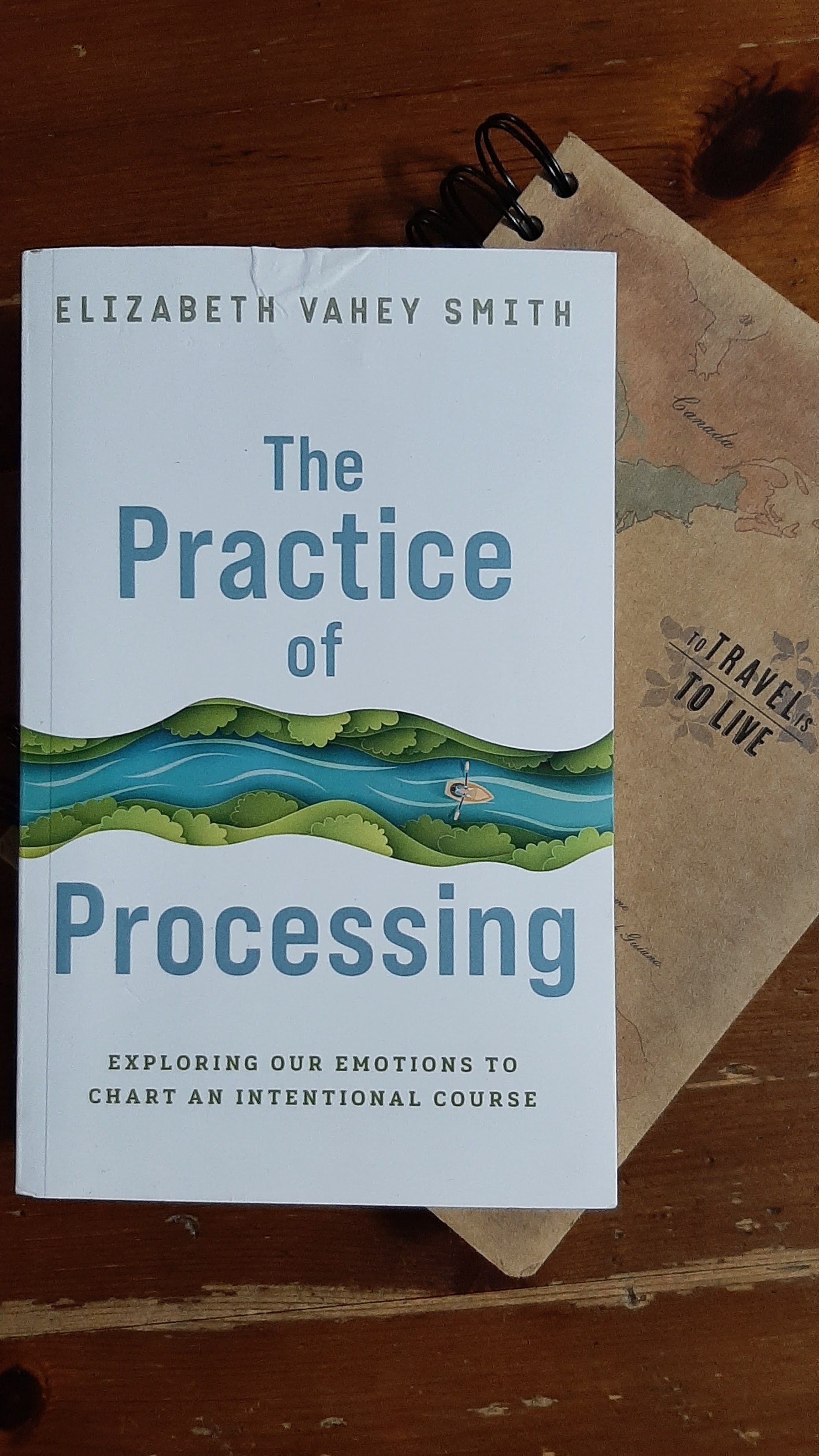
THE PRACTICE OF PROCESSING by Elizabeth Vahey Smith is just what the book title says. Elizabeth had those who transition often in mind when she wrote this book. It is a book that I found to have the why one should process, but also provides a guide in ways to process. She begins with emotions and how understanding them as “communicative…we can intellectually process the new information they provide” (pp. 18-19). Emotional intelligence is important and she covers that topic well. Elizabeth also provides examples of how to help children process, which is a nice bonus for parents or those working with young people.
If processing is new to you then I would suggest that you look at this book for yourself. Or if you are in member care for your organization, then a nice resource for people who need help in this area.
It’s September* and everyone is back in school. Did you hear me sigh? Did you sigh along with me? Don’t get me wrong summers are good, but with a child with special needs they are usually not great. She needs a set schedule with a para and we don’t get either in the summers. Summer schedules are suppose to be flexible. They are to be a time to relax, take a vacation with the family, right?
So, with school starting and the schedule in place life would flow down a lazy river. Nice and easy. You’ve heard of the domino affect, haven’t you? You know after one domino falls, others go right behind it? Today’s story will follow the domino trail; not a lazy river experience.
Domino #1: Beach & Teas
It was a school holiday, Mid-Autumn Festival. So, off to the beach we went for the morning. Just the two of us because the other two were out of town. The sky was blue, the wind was strong, and the sand was warm. M2 rolled around in the sand and waves, built sand mounds, and ran up and down the empty beach. Perfect.
Teas are usually something we buy to take to the beach, but since we left so early there were no shops open. So, after rinsing off the sand and sweat we stopped at a shop before going home. My wallet was at home, but I had a zip-lock full of copper coins. They are worth 1 New Taiwan Dollar. I ordered and paid with 110 coins. Bless those workers hearts as I counted out stacks of ten coins eleven times. (Maybe you are wondering why I had a bag of coins in the car. Well, I’ll save that story for another time, but you can try to guess in the comments.)
We got home and I put the teas in my bag.
Domino #2: Keys & Flipflops
I gathered all our belongings and coaxed M2 out of the car. She is sometimes a sloth when she wants to be. I reminded her that we had tea and then threatened that she would not get tea if she didn’t hurry. Mama had to use the bathroom.
We live in a house with a yard. To enter you have to unlock a tall solid metal swinging gate. Ours is blue. I fanned out the keys on my key ring, but could not find the key to this gate. I looked through the bag to make sure they didn’t get buried under the towels and sand.
“No! Please don’t tell me I left them in the house?!?!”
M2 giggled, snorted, and smacked her leg.
I dropped the bag and climbed up the side wall to see if I could be like my super amazing husband who climbs over and jumps down. I looked down. It’s about a 6-7 foot drop, so not bad. But I looked at my shoes. Flipflops. I was not sure my ankles could take that jump onto concrete. And I was sure our dog looking up at me wagging her tail would not catch me either.
I called a friend who has an the extra set and lives just down the road. No answer.
I found a curved tool in the hedges. “Oh, Lord, please let me jimmy this door open. I really need to use the bathroom and need your help.”
Nothing. I try several times. Nothing
I felt my breathing pick up and my heart rate quicken. By this time our dog was whining on the other side of the gate.
I tried once more, probably with a little more frustration than wisdom. But the door popped open. I got in and I didn’t break the lock. A miracle, I think.
Domino #3: Wet bag & Wet Keys
After washing my hands, I went to the kitchen to retrieve our teas and get something for lunch. My bag was wet. Soaked. I reach inside and pulled out one full cup of tea and one empty cup. When I dropped the bag, the seal on the tea opened and out went the tea onto everything, including my car key which has a battery operated button to unlock it. I ran everything under the water to rinsed it off and then gave M2 chocolate almond milk. She was just as happy with that.
Domino #4: Car Alarm
Two days later we used the car to go to church. The key fob has the buttons on it to lock and unlock the doors. They were not working. I manually unlocked the doors and we drove to church. Later that day we were heading to pick up a friend to go to the beach. The car began to lock and unlock on its own. Strange, but I thought, “Maybe the keys are still wet and they just need time to dry.”
Monday morning same, but not a huge deal. Monday afternoon, I go out to the car to pick up M2 from school and the car alarm goes off when I open the door. I cannot get it to shut off. I try several times to unlock and get in, but the alarm goes off. One time I get in without the alarm going off, but then when I started the car it went off again. A little later, I had the car started, but when I pulled out of the drive the alarm went off again. By this time it had gone off four times. I was loosing my mind.
I call handsome hubby. Bless his heart, he was of no help.
“Push the button on the key fob, that will turn it off.”
“Really,” I said, “You don’t think I’ve tried that? It doesn’t work.”
“Oh, then I don’t know what to tell you, but you have to get to school now or you will be late to pick her up.”
This conversation was going on while the alarm was going off. You can imagine how we were both feeling.
I prayed, “Oh Lord, please let this crazy alarm stop. I cannot go down the street with it going off. Please don’t make me stand out any more than I already do!”
It stopped.
I sent handsome hubby a message asking him to let the teachers know that I was on my way.
He messaged back: “I’m sorry I was not helpful. I was mad because I wasn’t there to help you. I’m glad you got it to stop.”
I love that man.
M2 was in the office waiting for me. I did not turn the car off, but left it running while I ran in to get her. We went straight to the mechanics and asked him to disable the alarm system. He did.
With a chuckle.
Conclusion
Dominoes are fun to watch as they cascade around their merry path. But when that path is your life and it is affects so much of what you do, then that is not so much fun. In fact, it can make you aware of thoughts and emotions that you have about yourself, others, life, and/or the world. I’ve been studying Rational Emotive Behavior Therapy in my final class for my Master’s in Care and Counseling. The biggest takeaway is that beliefs directly influence our emotions and behaviors; not the situation or the event.
Example from my story. The moment I realized that I left the keys at home and did not have them to open the door triggered a belief. The belief that I should never do such a stupid thing like forgetting to take the keys to the house with me and this is terrible, I’ll never be able to get in. This belief started the domino affect of me dropping the bag; not setting the bag down. You could probably go back and see where this belief rises back up at various points in the story. How to change your beliefs is through disputing them, but I’ll save that lesson for another time.
*This story was supposed to be published in September, but for some reason I forgot about it. Maybe it was because I needed to understand REBT more and could begin to introduce it to you all as a way to process events/situations in your own life.
Last spring my oldest graduated from high school. Six months ago I was just beginning the ride on the “transition roller coaster” and learning to navigate this new kind of transition: parenting an adult TCK. It was unknown territory. I’ve been in the land of unknowns before – finding homes, adjusting to new countries, learning to parent a child with special needs – but this one felt different. It wasn’t my life that had all the unknowns – it was his.
As his mom, I wanted to step in and find all the answers. Let me be real, I wanted control. If I had control, then I’d know who would be traveling to the US with him (thank you pandemic), what insurance to get, who his friends were going to be, what his Christmas break plans would be….you get the picture. I really just wanted to know that he would be okay.
I was reminded of a hike I took with my son a few weeks before graduation day. It was on a mountain path that was near his campus and overlooked the city. On our way down, he seemed to leap and skip down the steps. He’d disappear around bends. At one of those bends I heard God whisper to me, “Let him go. I know you can’t see him, but I’ve got him.” (and let’s be honest, what 18 year old boy wants his mom controlling his life?)
And that is what the last half year has been for me – practicing and actually trying to do what God asked me to do on that mountain – Let him go.
The photo above is a very simple illustration of my heart. It is dragging a bulging suitcase full of heavy rocks that I have packed and stuffed diligently. (One perk of living overseas is the ability to pack a suitcase well, right?) The rocks represent everything that I want to control because it isn’t just things in his life that I want to control. I’d like to control everything in my sphere of influence. Wouldn’t we all?
Some are small.
Meal plans
Math lessons for my youngest
Regular health checkups for me and the kids
Some are big and heavy and honestly, cumbersome.
Oldest in isolation last month
What will my daughter with special needs do after high school?
Braces?
Feeding tube incision leaking…needs surgery?
These are just a few of the “rocks” in my suitcase. Collectively, these rocks are heavy. Too heavy for me to be dragging around with me from place to place, day to day, year to year.
When we believe that having control is the answer, we miss out on peace.
Looking back, time allowed answers to unfold to some of the unknowns. Yet, now there are new unknowns.
Isn’t that like us though? Replace the old with the new? I mean we replace old clothes with new. We replace old batteries with new. So, why wouldn’t we replace old worries with new – or even better just become a Hoarder and add to our already collection of worries.
I guess that would be called a Worry Hoarder?
I want to propose something though.
Look at where the eyes of my heart are. They are on the suitcase that I’m dragging. My focus is on those rocks that represent worries and anxieties that I want to control.
What if, I shifted my eyes to the mountains. Psalm 121:1-2 says, “I lift up my eyes to the mountains – where does my help come from? My help comes from the LORD, the Maker of heaven and earth.”
That simple shift of realizing who is really in control and then trusting God to be all that He says he is is monumental is stepping towards peace. It is simple, but I will not say it’s easy. It is choosing to trust and believe.
I’m sure that if you live overseas, have lived overseas or are parenting TCKs (children or adults) you have your own “rocks” that you’ve been lugging around as well. And with this year of so many unexpected surprises and unknowns, I’m sure your suitcase is bulging, too.
I bought this painting last weekend at a local artist market in Taiwan. It is where I want to be. Sitting on that bridge with my legs dangling over the side looking up at the mountains.
So, my question this week is this…
Do you want to be a Worry Hoarder or would you rather be sitting next to me.
So, here’s to parenting more on my knees before God.
It is the night before Mother’s Day. For some reason my mind traveled to a time period fourteen years ago. I was a young mom about to hear my daughter’s diagnosis. With time wisdom grows. It’s through this wisdom that I wish I could have shared these few thoughts with that mom I was back then.
Dear Younger Self-
I know you forgot what today is, but let me gently remind you. It’s Mother’s Day. Don’t put your head down in shame. I know you’ve lived with your mother for the past several weeks. I know you forgot to buy even a simple card to thank her for her selflessness. For all the drives to the city, waits in the hospital, and the endless cooking she has done for you. I know you wish your husband and almost two-year old son were with you instead of back in China. The hospital visits and tests have taken a toll on your mind and body. It’s a scary place to be. You’ve talked with doctors, and even specialists. You’ve held your baby while nurses have poked her with needles. Yet, still no results. No diagnosis.
Emotions will visit you, strong emotions that will come when you least expect it.
Fear…
Don’t play the “What if” game. It will open wide the door to Fear. But, I know you will. The questions will come at you like quick shooting arrows. “What if she never walks?” “What if she dies?” “What if we have to leave China?” Don’t worry; he gets the best of me still today with his quiet whispers of doubt. Fear wants to consume you, but he won’t. Your daughter will get the diagnosis you don’t want to hear – Cri-du-Chat Syndrome. Your mother will be next to you in that small room in shock. Maybe it is a mother’s instinct, or maybe not – but you won’t be shocked because deep down you already know. Your world will be shaken though. Your baby will need a feeding tube. You will feel like all the air was taken from your lungs. Sit tight – the God who created that bundle of joy topped with red curls already knew. He’s not surprised. So, just breathe – in and out, in and out. You will feel like waves are pummeling you to the bottom of the sea, but dive deep into those waves. It is there where you will find peace. Dive deep into the peace that passes all understanding, the peace that comes from our Lord Jesus Christ. Just breathe.
Grief…
Grief will come, in fact, she already has. This Mother’s Day you will grieve for that child you thought you knew. You will cry hot tears that seem to never run dry. They are tears of healing. Release them. Let them wash over your face while they wash over your heart. I wish I could tell you that Grief eventually exits your life, but I can’t. She will come back when you least expect it. Fourteen years later, she still visits me. When I see other kids in middle school laughing with their friends at the local 7-11 or tying up their shoes about to play in a soccer tournament, she comes back. My throat tightens and my eyes begin to drip tears. And there she is. Grief dressed in black. I’m learning that Joy can accompany Grief. It is those times I offer gratitude and praise that Joy is also there. I give thanks for what Matthea can do and I praise God for his many blessings in our life. So, as you grieve this Mother’s Day know that “joy will come in the morning.”
Loneliness…
This Mother’s Day you will feel lonely. Uwe and Marcus are miles away. You feel like you are the only one going through this, yet you know that is not true each time you enter the hospital. But, Loneliness comes and tries to squeeze out those in your life who love you. Don’t let her. Remind yourself that you are not alone. God is there with you. Your family is there. And remember your friends just drove a few hours to spend time with you. They are praying for you. Don’t let Loneliness crowd out the others.
Guilt…
Yes, you will feel guilt. Guilt will overshadow Grief. Guilt will remind you of friends who have lost children. Guilt will point a finger and say, “You’re child is living. Why are you grieving?” You won’t really know what to do with Guilt. You will try to hide Grief, but it will still be there. I want to give you permission to block Guilt out of your life. You have permission to grieve. This diagnosis is hard. There are a lot of unknowns. It is scary. So, don’t believe Guilt. Pray for those friends and be sensitive when you talk with them, but don’t bow down to Guilt.
Hope…
You may not feel like there is any hope right now, but she is there. Hope will come pouring in when you find out that you can go back to China. Hope will come when you gain confidence in using the feeding tube. And even this day, Hope will come in a form of a Mother’s Day gift from your sister. A small cut rock that says, “A Mother’s Love begins long before we can remember…And brings us Warmth and Happiness We Never Forget.”
Give yourself some grace today. Your love for your children comes through. I can’t tell you that everything is perfect and life is like a rose garden. Life isn’t easy. I mean whose life really is easy, huh? But, life is good and full. I can’t tell you all the great things because you need to experience some surprises in life.
I wish that the decade older version of me would send me a letter like this. I sure would like to know how these teenage years turn out.
I’ve so enjoyed this little series on leaving and want to thank again all those who have sent in stories to share. Today’s guest post comes from an ATCK who writes books for and about TCKS. You can find my interview with Valérie about her book, B at Home: Emma Moves Againhere. Please welcome, Valérie and what she as to say about being left behind.
At most international schools, June is marked as the ‘leaving month’. Last year, I wrote a piece here specifically about leaving and saying goodbye. It was prompted by people leaving, people close to us dying, and a lot of grief. “Partir, c’est mourir un peu” (translation: Leaving is to die a little), but I have come to realize that staying is as well. This school year, my focus is shifting towards ‘staying’.
Clearly, being left behind by loved ones who pass is an entire different kind of loss. The abruptness of death’s goodbye can be heartbreaking and so few words of comfort can do justice. However, in terms of the global mobile lifestyle, we are often granted the luxury of anticipating goodbyes. Staying au lieu of leaving confronts us with just as much loss. Perhaps even more, because when others leave, we are left with a certain emptiness. And as the emptiness is not filled with all the new input that comes along with starting again somewhere else, the emptiness can sometimes be more overwhelming than we imagine. After all, when we stay, we are not confronted with intense changes to our lives on almost every front. Yet, our lives do change forever.
Last year, I had to say good bye to one of my closest friends and her family. When they left, my daughters and I had to part with certain small rituals and traditions that we had built up together with my friend and her daughters. At the ages of three and one, my girls didn’t understand why we didn’t have regular play-dates any more. Even after traveling on many trans-atlantic flights to visit grandparents, distance is not an easy concept for a young child. Months after our friends left, my three-year-old would still ask if we would meet up with her friend when we drive to the local playground or in the general direction of their old house.
When we are the leaver, or the mover, nothing can ever replace what or who we leave behind, but eventually the transition curve catches up and excitement about what is new catches on. When we are left behind, eventually things do fill up the empty space that other leave, but we all know that filling up never replaces. And then the seasons pass, and the people who fill up our lives become the very ones who we grow another attachment to and who we will need to say goodbye to at another point. The cycle of mobility doesn’t stop, and most of us wouldn’t even want it to.
As an ATCK, teacher and mother, and passionate about the subject of children and mobility, I do believe we can help our children become strong leavers and stayers. With the luxury of anticipation, and the research-based evidence of the effects of unresolved grief and mobility on a child’s life, we owe it to our children and students to provide them with the tools and language to say goodbye properly. To be able to leave well and to be able to be left behind well, is the beginning of intentionally jumping into a new journey.
As many TCKs feel that their idea of ‘home’ is associated with a sense of belonging, this attachment to ‘home’ changes when people around them leave. It is important to ensure that they are supported in their transitions as well. Just as there is an art to leaving well, there is most certainly an art to staying (as) well. For the first time in my adult life, I am moving into my sixth year in the same house, in the same town, holding the same job. For the first time I am starting to feel like a stayer, without losing sight of the probability of leaving again one day, and it is putting so much in perspective.
Thanks Valérie for taking time to write for us today.
Originally Dutch, Valérie Besanceney grew up changing schools and countries five times as a child. She is a quintessential Third Culture Kid (TCK) turned adult, with a passion for traveling while cultivating a strong sense of home. Currently, home is in Switzerland, together with her American husband and their two daughters. Apart from writing, Valérie loves teaching Year 3 at an international school.
Valérie’s first book, B at Home: Emma Moves Again (Summertime Publishing), is a fictional “memoir” about the experiences of a ten-year-old girl and her teddy bear who have to move, yet again. During the different stages of their relocation, Emma’s search for home takes root. As the chapters alternate between Emma’s and her bear’s point of view, Emma is emotionally torn whereas B serves as the wiser and more experienced voice of reason.With this book, Valérie hopes to give younger TCKs a story that they can identify with while they experience their own challenging move.
Her second book, My Moving Booklet (Summertime Publishing), is designed to help children through the initial stages of an upcoming move. Moving can be exciting and terrifying at the same time. It can be very sad to say goodbye, but it can also be incredibly fun to experience new things and meet new people. Everybody experiences a move differently, but it is very important to say goodbye properly. This booklet allows children to truly welcome the new challenges and adventures that lie ahead of them, together with their parents and teachers. In many parts of the booklet, they will have the opportunity to either write about it, to draw a picture, or to glue on a photograph. This is their own unique story that one day will serve as a keepsake of a life-changing event.
Today’s Leaving Story comes from a fellow blogger I started following years ago. I was drawn to Janneke’s blog, DrieCulturen, because I felt a connection with her writing. She was one of the few European writers sharing their TCK stories – it helped me understand my husband a bit more. Today, Janneke’s shares her story along with some insightful tips to help your university-bound TCK.
May 1989. For most people it was a normal day in mundane life. This was not so for everyone. In the suburbs of Bulawayo, Zimbabwe, Africa there a 19 year old young girl was frantically trying to fit the last things into her bags. Between the last-minute packing were the last minute goodbyes. Very soon the car was leaving for the airport so there was little time to spare. Her viola would be part of her hand luggage; her tennis racket was strapped with broad tape onto the viola so that it would accompany her, too. Her parents, brothers and sister would all see her off at the airport. Of course there was a last family photo in front of the map of Zimbabwe. This was a historical moment.
The 19 year old was leaving home. She was leaving “the nest”, spreading her wings and flying out into the unknown! She was the firstborn so she was the one to pave the way for her siblings. So with her head up, and gathering all her earthly belongings, she was going to board the aeroplane. Walking on the pavement heading to the plane the strap of her bag broke, obviously her bag was not designed for the amounts of luggage she had piled into it. Was this how the rest of her journey would go? In front of all the farewell sayers she was once again grabbing her belongings together and trying to make it to the plane in time. One last quick wave and she was out of sight. Finding her seat was easy, she was a routine traveller. The engines started, and then it was time for take-off. One last glimpse of the ones she loved, of the country she loved, of everything that was so well known to her. Before she could stop it there were tears streaming over her face. Not just a few tears, it seemed like a dam wall had broken and there were floods of tears. Something like the Victoria waterfalls in the rainy season. The tears were uncontrollable.
The past week had been busy and filled with goodbyes. There had even been a goodbye party, with school friends and friends from the church youth group. They had had a lot of fun, there had been lots of laughter but there had also been the painful goodbyes.
This was the country where her family had lived the past 6 years. Here she had cycled to school daily, she passed her driving test, she had received her first kiss, her first dance, her first date, she had turned eighteen, been a school prefect and she had written her “O” and “A” level GCSE school exams. This was the continent where she was born. Here she had learnt to walk, run, play, and laugh.
In Africa she knew she wasn’t African and she thought it was because she was Dutch. Now, in Holland she found out that she is not really like the Dutch people either. Where was home? She remembered that her younger sister had asked that questions years ago. Her sister decided that “home” was where her bed was!
Of course I am the person in this story. I am the one that was born abroad. I am the one who was called “the foreigner” at secondary school. I am the one that did not quite fit in. I am the “hidden immigrant”.
Looking so Dutch but not knowing how to weigh the fruit and vegetables in the supermarket. I remember observing the people around me, watching to see how others did it. How do you use the buses and the trains? Were the supermarkets open on public holidays or not? Some times I asked questions, but people would look at me and you could hear them thinking “how can she be so ignorant?” Which brand margarine should I buy? There were just too many choices to make. Even more difficult was: what clothes do you wear and what must you buy? I had been used to wearing school uniforms all my life. As a young child my mother always tailored the dresses, she even did the hairdressing.
Looking back, I think I was not fully prepared for this flight out of the nest. It turned out that I made a crash landing but somehow I survived. I still miss the warmth of the African sun. My heart yearns. My heart longs. I miss the continent of my first kiss.
Tips:
Prepare your kids for their transition to university.
Talk lots about the emotions, expectations and practical things.
Read the book “A Global Nomad’s guide to university transition” by Tina Quick and give your young adult a copy.
If possible transition with your child or make sure there are family and friends near their university, where they can easily visit.
Make sure they have heard the term “third culture kid”, something I did not know.
Choose a college or university that is internationally minded, where there are more TCKs or international students, chances are your TCK will feel more at home in this environment.
Thanks, Janneke for sharing your story with us! If you’d like to read other stories about leaving please click on the links: Part 1, Part 2, Part 3.
Remember, if you’d like to share your own story, there is still time to get them in. Click here for details.
Janneke Muyselaar-Jellema is an adult third culture kid, M.D., and blogger @DrieCulturen “all about kids growing up in other cultures”. You can also find out more about her story as a guest writer for Rachel Pieh Jones here.










 raisingTCKs