Rachel, an ATCK, takes the reader on a journey through her poems to the various places she has lived. She tackles some deep issues of race and the plight of refugees, but she also muses over ordinary meals in a farmhouse in China. The book is divided into two sections: “Bright Sadness, Bitter Joy” and “A Deeper Knowing.” But before the sections begin, she starts with a poem titled “Sojourn,” a title that anyone who has lived outside of their passport country may feel, but Rachel takes a different spin —one that everyone can relate to.
Recommendation:
This collection of poems takes the reader on a global journey where many paradoxes take place. Rachel uses her own experience and her gift of words to portray a sensory scene from the realms of the Himalayas to the chaotic feel of post-racial conflicts in Maryland. She offers a space to stop and reflect on what is going on in the heart and mind — to ask the deeper questions of life and to hold the tension with grace.
*Please note that I earn from qualifying purchases as an Amazon Associate. Please see the disclaimer at the bottom of the page.
This resource is a set of 14 cards to help start conversations for families planning an upcoming move. Each card is focused on one aspect of transitions. The card explains why this aspect is essential and then offers questions that families can discuss. Laura also offers other ways besides talking to help your third culture kids transition to the new place.
Recommendation:
While these cards are meant for a family preparing to move, I think they would also benefit families who are the Stayers. Many cards deal with the same issues that those who Stay deal with. I feel a parent could also adapt the wording to help children in that kind of transition. The quality of the cards is durable and comes in a nice box that makes it easy and light to pack and take with you. The other positive aspect of these cards is that families only need one set per family, which can be reused repeatedly.
*Please note that I earn from qualifying purchases as an Amazon Associate. Please see the disclaimer at the bottom of the page.
Summary
Ulrika is a Swedish missionary kid (MK) who grew up in what was known as Congo. She also raised her five children in Thailand where she worked as a therapist at The Well International. She is a social worker and a licensed psychotherapist. This book is a compilation of the many hours working with globally mobile families. It is divided into eleven sections with fifty-seven short chapters. Each chapter is filled with information, but the best is that at the end she offers interactive activities that can be done with the family or in groups. She also offers ideas for parents, sending organizations, but also ideas for the TCK as well. While the focus is mainly on MKs, she believes that the activities are also beneficial to TCKs. There are a few chapters that touch on the specific issues that MKs face regarding religion and the expectations of parents and sending organizations.
Recommendation?
Let me tell you if you couldn’t tell by the photo. This is probably the number one book I would recommend for parents or sending organizations to have on hand. The resources and activities are simple to execute and offer a great way to start conversations with TCKs and ATCKs. I liked that the chapters were short and to the point. She gave some examples but did not overuse them. Her interactive activities are good and easy to do. As someone who works with TCKs and their families, I’m very thankful for this resource.
I wrote this article four years ago for Multicultural Kid Blogs. I have updated it. This newer post fits into the transition model, DOCK, that I created for the Stayers. This can be used by globally mobile families for their TCKs.
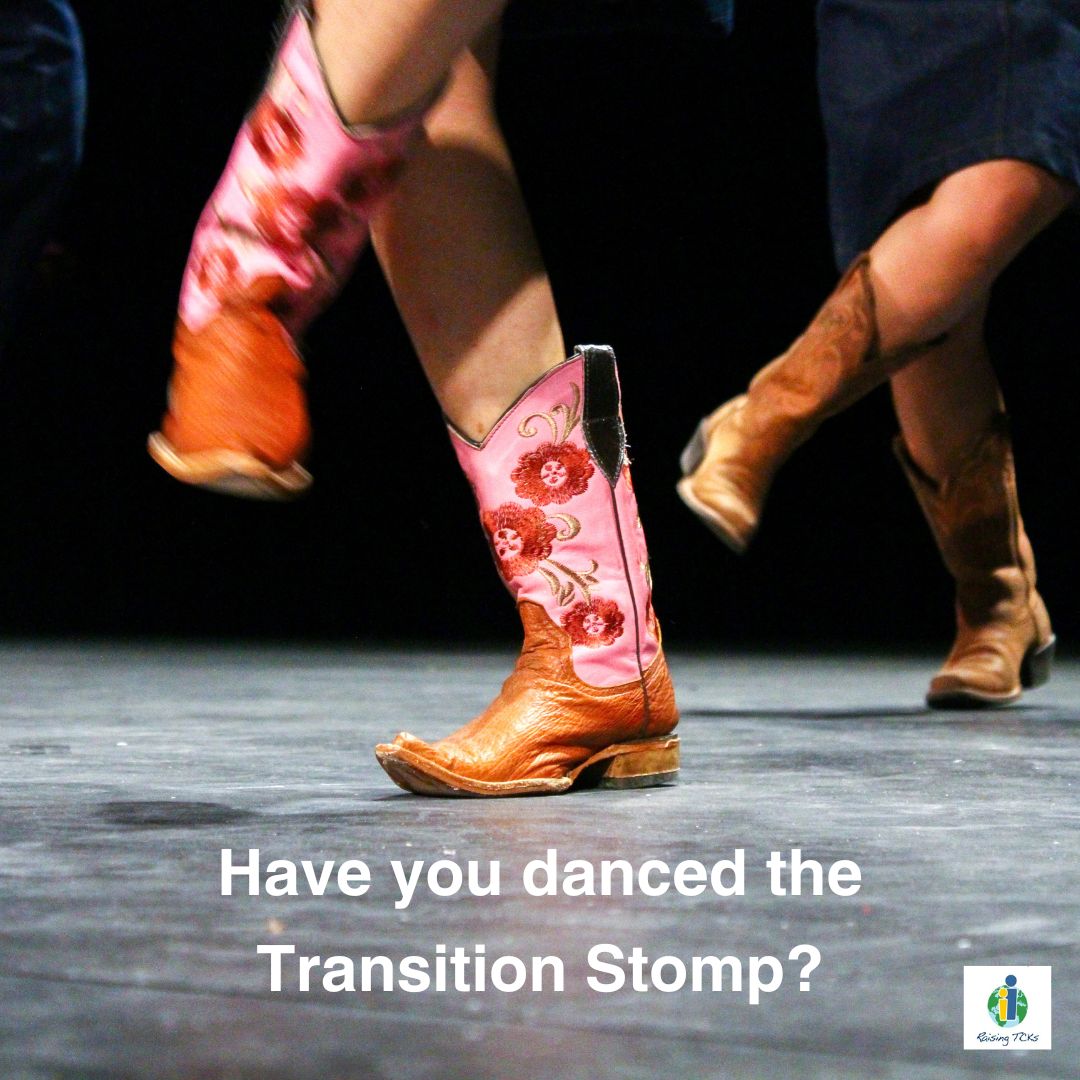
Transition is part of life. People move. Children come into the family. Special people and pets die. For those living overseas, this rhythm of transition brings an odd normalcy, which one could easily sway or tap their foot to. Just listen –
In and out,
come and go.
Up and down,
arrive depart.
Turn around
and
Start again.
But, after a few years of this dance, kids’ emotions may stop swaying and tapping. Instead of dancing, you may find them on the dance floor just going through the motions. Or maybe they are standing against the wall, avoiding the dance, waiting for the song to finally end. They know new people will come and join the dance. But the question that lingers is: “But for how long?”
They know new people will come and join the dance. But the question that lingers is: “But for how long?”
How do we help our kids not build a wall around their emotions?
This is a complex question that has no simple solution. Here are a few ideas that can help. It won’t take the pain of saying goodbye away, but it will help your child know that they are not alone in this transition.
Observe your own heart. Where are you? Are you on the dance floor going through the emotions, or are you engaged with the people around you? Or are you standing against the wall, hiding from all the new people jumping and twirling around?* Just like the oxygen masks in the airplane – first put your own mask on before assisting your child – first process and grieve this transition so that you can help and assist your child. Or at least take time to process on your own, so that while she is in the middle of it you can be there to support and comfort.
Talk about it. One of the best ways to release and process grief is to talk to someone about it. Find a friend or safe person to talk to. Then you can be ready to ask good open-ended questions and listen to your child. Ulrika Ernvik says in her book Third Culture Kids: A Gift to Care For, to offer your child a “bubble”. This means to make a comment like, “I’m sure having to say good-bye to your friend must be really hard.” Then wait and see how your child responds. Ulrika does say that you may need to wait a few days as the child may need time to process your statement.
Be there. This is a follow-up to #2. When they begin to talk about it, stop and listen. You do not need to say anything. We don’t need to “fix” the problem. We just need to validate that the emotions the child is feeling are okay. Affirm that they are normal. Ideas are rubbing your child’s head, holding them while they cry, or sitting and crying with them.
Make a memory. This could be as simple as planning one last fun outing with your child and their friend who is leaving. Or it could be helping your child make a card or photo book to give to their friend. Take photos. Be the parent that is annoying. They will thank you later when they can scroll back over all the photos.
Help them stay connected. What are ways that are appropriate for them to keep in touch with each other after the friend leaves? Help them understand that their relationship will change and shift but that they will always be friends. Understand that as this friendship does shift and change your child will also experience another wave of grief. Go back to #2 and #3.
*Please know that sometimes standing along the wall is okay. In fact, it is healthy. Our grieving hearts need a break to heal. Sometimes, two months is not long enough. Sometimes, it takes longer. So, stand at the wall and watch. Have some coffee or tea. Grab a scone to go with it. Grab a chair and sit next to another Stayer who is sitting out this round of dancing. The key is to remember that you are just taking a break. It’s temporary. Eventually, you will need to get back on the dance floor. Remember this for yourself, but also for your kids.
If you need more resources for transition, check out my business, Global Crossroads Consulting. I offer individual consultations, family transition talks, school transition talks, and debriefs.
Disclosure: This post contains Amazon affiliate links. If you click and purchase, Raising TCKs blog will receive a small commission to maintain this site.
Summary:
Khosrou fled Iran with his older sister and mother in the middle of the night. They were refugees in Italy and then landed in Oklahoma, USA. The kids in his class are unsure of this dark-skinned boy whose lunch smells weird and tells stories that sound like something from the movie Aladdin. In Oklahoma, Khosrou is called Daniel. It is a true story of a young boy learning to adapt to a new culture while trying desperately to remember his family’s heritage.
Why I reviewed this book:
As the definition of a third culture kid (TCK) has evolved over the years, it has now become one of many subgroups of what is known as a cross-cultural kid (CCK). This was explained in detail at the International Third Culture Kid Conference (ITCKC) 2023. They reported that research shows that many of the subgroups of CCK have many similar shared experiences. This book is not a TCK book but rather that of the subgroup of refugees.
Here are a few of those shared experiences:
learning a new language
eating new foods
living between two worlds: the American school life and that of home culture
I recommend this book to anyone over the age of 12. It has won many awards for good writing and for a children’s book. But I also recommend it to adults as we can relate to the themes as we are trying to raise our own children.
My Favorite Quote:
“Would you rather a god who listens or a god who speaks? Be careful with the answer.”
Daniel Nayeri, everything sad is untrue, page 216
This question and his conclusion continue to bounce around my brain, as it is such a good question. You’ll have to read the book to find out for yourself his answer.
This seems to be the theme of 2020 for me. Our oldest graduated from high school, decided on a university, and will get on an airplane in less than five days. To be honest those three words bring out emotions, but with this pandemic can I demonstrate by writing “EMOTIONS!”? Seriously, I think sending off your first is suppose to be a roller coaster of emotions, and having a TCK and all that entangles makes those drops a little more steep, but throw in a pandemic and it’s like a sudden double loop with a fear that the safety harness is faulty. This is coming from someone who doesn’t like roller coasters. For those of you who do, well, come up with your own analogy. But, to break it down, this year has brought out these emotions:
And here’s the thing I’ve noticed this week. Especially this week. I’m not the only one going through these emotions. Of course my son is going through some of this, but my husband and daughters are as well. And as the time of departure nears, the emotions heightened.
And get this – we all respond to these emotions DIFFERENTLY! Maybe you already knew this and I think I did, too. But, this week with everyone just a little more on edge I’ve really noticed it.
So, what to do?
I’m not sure I have a complete answer, but here are a few things I have tried to do to help.
Be aware. Be aware of your own feelings and responses to those feelings. Be aware that others may be acting out of response to anxiety or deep sadness or even fear.
Choose Grace. Grace is a Christian word that basically means gift. Offer the gift of understanding when a young child throws a tantrum at the table. Give grace to your spouse when you find them “hiding” in a book, TV series, or game. Giving grace sometimes means forgiving before it’s been asked for. Don’t forget to give yourself grace. It’s easy to be hard on yourself, but you need grace, too.
Communicate. When you are aware of your own actions and responses you can communicate with your family how you are feeling. You can ask for forgiveness when you’ve spoken in anger because of stress. You can ask how they are doing with this upcoming change. You can talk with them about their own responses/actions. Remember though, that HOW you communicate is key – go back to #2 for guidance.
This is not something that comes naturally for me, so please don’t read this and think, “Wow, she’s got it all together.”
Uh, no, I fail multiple times a day with this. I sometimes I wish we could just rush through this hard part of transition – but I don’t want to miss it. So, I will hold on to that safety harness and force my eyes to stay open through all the dips, the dives and the loops that this roller coaster brings.
Have anything else to add to this list? Please share in the comments.
Last week I tripped and fell while running. Okay, let’s be honest, it was a slow jog. Anyway, I ran on a path that I regularly run on. I’ve run on this path for several years. I’m familiar with this path. Most mornings I turn on a podcast before pushing start on my app that tracks my kilometres. I run down the empty road with traffic lights still flashing red towards the path. It’s an old railroad track that the city has turned into a really nice walk/run/bike path. It’s lined with trees and flowering bushes. About a fourth of the way into my run, I cross a bridge that opens to a view of the mountains. It’s gorgeous and honestly one of the reasons I get up so early to run.
That morning though, I remember turning around to head back. I was laughing at something the host of the podcast had said when my foot caught on something and I stumbled and crashed to the ground.
How did I get here?
I stood up and looked at my knees. No scratches. I couldn’t believe my luck.
I took several steps. No twisted ankles. Wow, this is amazing!
All seemed good.
A throb came from my right hand.
A quick look revealed the source of the pain: a thick slice of skin between two fingers ripped off.
Really?
I squeezed my hand into a fist and jogged home – hoping I didn’t have too much blood running down my arm.
The next day I ran again and stopped where I had fallen. The section where I had tripped had changed. It went from a smooth path to slats of wood before changing back to the smooth path.
A transition.
PC: MaDonna Maurer
My son leaves for university in a few weeks. I feel like my life resembles that path. I’ve been mom to this kid for over 18 years now. I’m familiar with mothering – but it’s changing. This transition feels like those slats of wood. It’s uneven. It’s loud. It’s not comfortable.
It’s uneven – Just as the boards are not evenly spaced, parenting during a transition isn’t either. It’s an awkward dance of letting him become an adult and still have some control. It’s knowing when to let him make his own decisions and mistakes. It’s more about coaching him and less about obedience. I’ve noticed this change in parenting a few years ago.
It’s loud – I feel like I’m a stomping elephant when I run over the slats of wood. That is why I run on the smooth bike path. It’s also loud in my head during this transition of parenting. The freak out voice seems to be shouting out all my fears and concerns, while the rational voice tells me that he is growing up and his decisions are not terrible. Maybe not the ones I would have made, but they are not going to ruin him. I’m reminded that I am now a coach and can only advise, but he needs to make decisions.
It’s uncomfortable – The uneven boards and the loud pounding make me feel uncomfortable – but I keep going as I know it is the right thing for me to do. Exercise. And just as this time of parenting feels uncomfortable with the uneven and loud feelings, it is right. He is growing up and needs to become his own person.
Transition is like that isn’t it? It feels uneven, loud and uncomfortable, but before you know it the path smooths back out and you are back to feeling normal.
So, here’s to making memories, watching him build his RAFT, and being attentive to my path as I finish this transition from mothering a kid to mothering an adult.
Reflecting takes time. And honestly, most of us don’t have the time to spare to spend it on such a “luxury”. It’s amazing how needy those little humans can be. If you have them in your home, trust me, they do grow and become somewhat less needy.
Unless they are a child with special needs.
Then, I can’t promise anything.
My daughter will be turning 17 next month and still requires most of my attention when she is at home.
In writing the first two sentences until this point I’ve stepped away from the keyboard several times.
Started some music for her to listen to in her room.
Put her hair in a bun.
Took her to the bathroom.
Changed music.
Answered the phone and door.
Put her hair in a ponytail.
Cleaned up the water she spilled.
Changed music again.
Reflecting in my journal is something that I need to do regularly for my mental health. But, as you can probably tell, I can’t do that with her home. Or at least awake. Years ago I began waking up at 4:45 am because she got up around 6 – no matter what time she was put bed. I needed my cup of coffee in S.I.L.E.N.C.E. with my journal, pen, and Bible. I was NOT a morning person, so this wasn’t easy to implement. These days she sleeps in until sometimes 7, so I’ve been working in some time to exercise – can’t say I’m as consistent as I am with drinking my coffee and writing in my journal, but I’m trying. (really, I am.)
With her graduating from middle school and getting to be home almost three weeks earlier than the rest of the school, I have reflected on how these weeks have gone and began thinking about her future – like when she graduates from high school.
I had a panic attack.
Would my life resemble these past few weeks with her home with me?
Would I have to totally give up ALL of my hopes and desires to be a writer, my projects that I’ve started on around the house, and stop any kind of normal social life or work that revolves outside the home?
Do I really only have three more years of freedom?
This week the theme at Velvet Ashes is on reflecting. And they are using the verse from 2 Corinthians 4:18, “So we don’t look at the troubles we can see now; rather, we fix our gaze on things that cannot be seen.” (NLT).
I was seeing lots of trouble. My focus was very limited and definitely not on the eternal.
But, honestly how do you change your focus from the here and now to the eternal?
Reflecting on the faithfulness of God in the past.
So that is what I did.
He provided schools when I didn’t think there would be one.
He provided therapists.
He provided hospitals, doctors, and countless people around the world to help with all medical needs.
He provided friends who are WILLING and ABLE to help out.
If He could take care of all those needs in the past, He is able to take care of her future (and mine). Taking time to reflect and remember, led to peace and acceptance (or at least the beginning) of what this summer will look like. And for that matter, what her future will look like. I still don’t know, but I can trust the One who does.
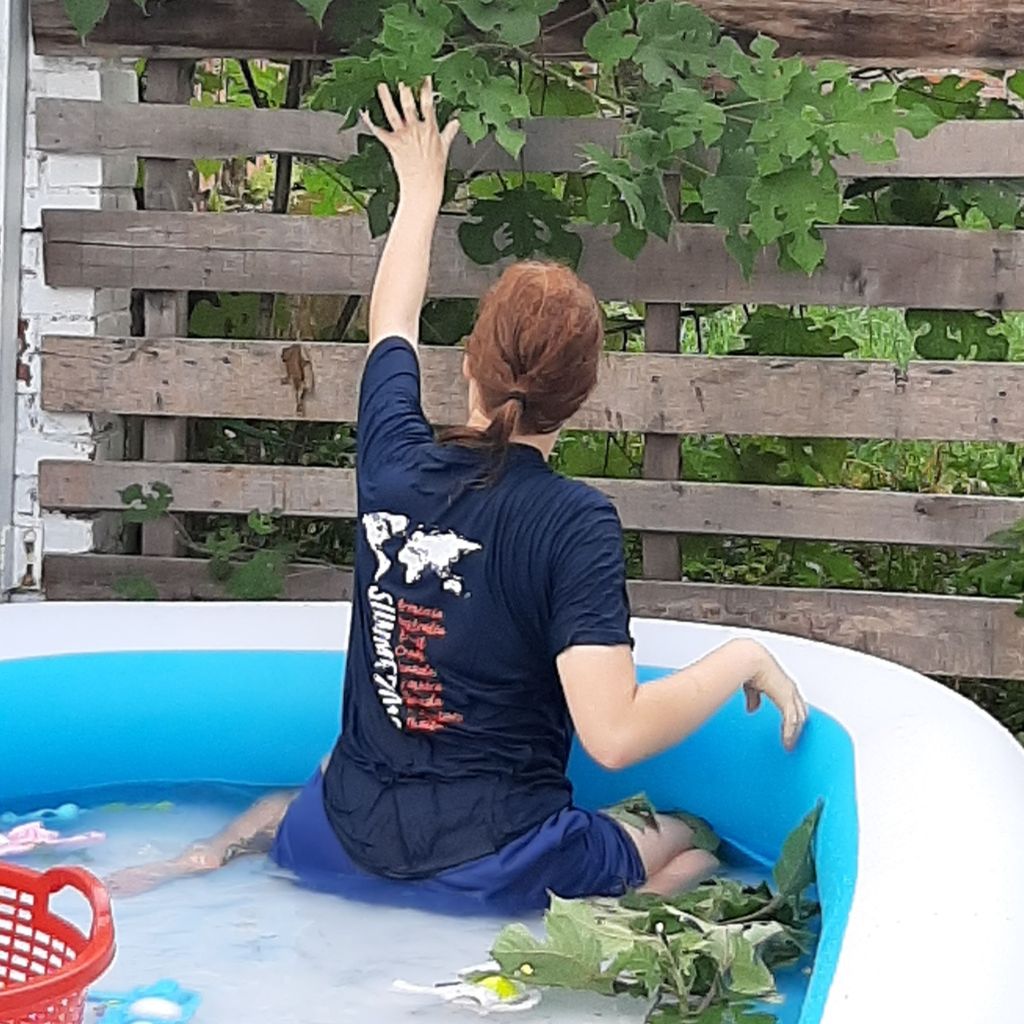
While finishing this post, she got outside.
PC: mdmaurer
So, I laughed, snapped a photo, and I brought my computer outside.
Win. Win.
Do you take time to reflect? When do you find time to do that? What have you reflected on this summer?
This post is part of The Grove with Velvet Ashes link-up on #velvetashesreflecting.
SHANGHAI PASSAGE is a collection of memories of the author, Gregory Patent, as a young child living in Shanghai at the end of World War II. Born in Hong Kong, Gregory was a British citizen to Russian and Iraqi parents. His stories are from the age of five, when the war ended, until he was around eleven when his family emigrated to the US.
My Take:
I picked up this book a few years ago from a school that was discarding it from their library. It has been sitting on my shelf and I’ve been wanting to read it. The cover has always tempted me to read it, but for some reason I’ve never taken the time. This summer I added it to my list for the Summer Reading Challenge by Amy Young. I’m so glad I did. Gregory’s story is just fascinating. The time period, the city, his cross-cultural family dynamic, and his opinions as a third culture kid – just a great read. He is truly a boy that has grown up, as Marilyn Gardener has coined, “between worlds“. As a mom raising some TCKs and CCKs, I was drawn to his thoughts about friends leaving, learning his father’s mother-tongue, and countless other things that Gregory shares in this very short book.
Honestly, I wanted to know more about this young man. So, I did some research and found that he is a cookbook author. You can read more about his life and try some of his reciepies at his website, The Baking Wizard.
I’ve come to conclude that no matter how long you’ve lived in a country you can always learn something new. Sometimes, it is as simple as a vocabulary word or phrase. Other times, it is something more cultural like holidays, food, or traditions.
And sometimes, and honestly most of the time, it is learning or relearning to obtain a teachable attitude sprinkled with humility (okay, maybe humility needs to be poured like water out of a bucket).
Why is it so difficult sometimes to do this?
I am an adult, I should be able have an adult conversation and not sound like a child, age 6.
I’ve lived here x-number of years and it still bothers me when I am told certain things about my body.
Why is it that I either have too many clothes on my baby or not enough clothes on? I’m never right?
The answer I believe to why it is so difficult is Pride. Some of us just have more of it than others.
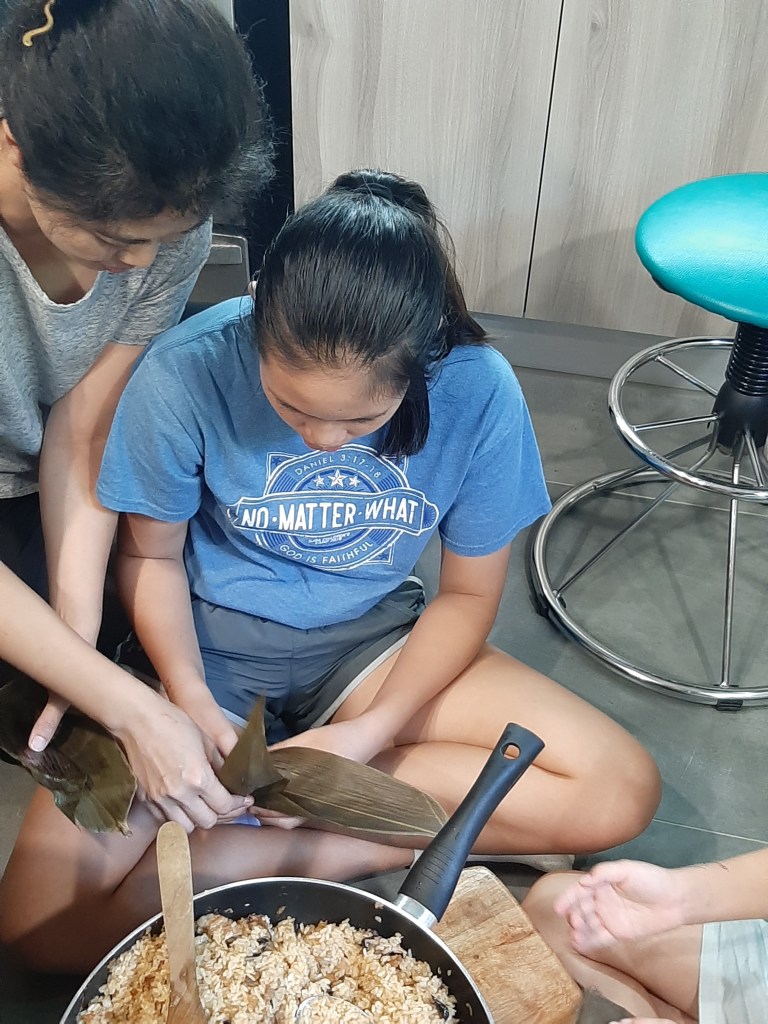
Yesterday was the Dragon Boat Festival. School is off for a few days and people are making zhongzi, which is sticky rice mixed with mushrooms, shallots, small shrimp, and sauces stuffed inside a bamboo leaf along with a piece of meat, duck egg yolk, peanuts, and another mushroom (or as I have learned this week, a variation depending on where you live). After the wrapped bundle is steamed, you unwrap it and eat the fragrant delicacies inside.
This week I was invited to participate with some other moms to make zhongzi. I knew this would be challenging, but fun and tasty. I honestly wasn’t prepared for what the challenge would really be. Let me unfold the events for you…
I watched as the “teacher” showed us how to do it. In my mind, I thought it didn’t look too difficult.
I could not have been more wrong.
On my first try I was told by one lady that it wasn’t a triangle. Another laughed. The “teacher” came over and took it out of my hands and showed me again.
I tried again.
And again.
And again.
Yep, I stuffed and wrapped, but according to those around me none of them were quite right.
Here’s where the battle began for me.
After the fourth one, as I was “laughing” along with the others, but on the inside wanted to through the ball of sticky-ness across the room – I had a choice to make.
Quit and be angry.
Laugh with them, but inside be seething angry.
Laugh at myself and keep trying.
The first option would be bad. Some of these women I’m friends with and I didn’t want to hurt their feelings or make them feel guilty. Honestly, their critiques were signs that they wanted me to succeed with this project – not put a dunce cap on my head.
The second one would be easy. I can fake emotions for the sake of the situation. (Don’t looked shocked! I know you can do it too.) And honestly, I did this for the first bit while I was thinking through my reactions (remember I wanted to throw it across the room). But, I didn’t like how it was making me feel.
As I looked around at the other tables, I realized that they were laughing at each other as they were also having trouble making them. You see, in my mind, I thought I, as the only foreigner present, was the only one getting critiqued and laughed at. Not true.
So, from that moment on I chose to laugh at myself and to keep trying. I’m not sure I made any that were exactly right, but I do know that I left with a better attitude and a bag full of zhongzi to feed my family.
My zhongzi bundle.
My neighbor’s zhongzi bundle. What it should look like.
Two days later another friend invited me and my daughters to her house to make zhongzi and jiaozi together. Let me say, I went into this situation much better equipped for the challenge that I knew would be there. Plus, I was able to help my daughter “laugh” at herself, reminding her that it’s okay not to get it right at all this first time. What is important is spending time with our friends laughing and talking; building relationships.
Photo Credit: MaDonna Maurer
Moral of my story? Don’t let pride stop you from building relationships with the people in your host country. They have so much to offer. And don’t forget that our children are watching us in how we respond to situations that seem a little difficult.
So, got a story to share on something you’ve learned or relearned? Please share in the comments below.











 raisingTCKs