To Throw a Zhongzi or Not to Throw it – that is the question.

Photo Credit: MaDonna Maurer

I’ve come to conclude that no matter how long you’ve lived in a country you can always learn something new. Sometimes, it is as simple as a vocabulary word or phrase. Other times, it is something more cultural like holidays, food, or traditions.

And sometimes, and honestly most of the time, it is learning or relearning to obtain a teachable attitude sprinkled with humility (okay, maybe humility needs to be poured like water out of a bucket).

Why is it so difficult sometimes to do this?

I am an adult, I should be able have an adult conversation and not sound like a child, age 6.

I’ve lived here x-number of years and it still bothers me when I am told certain things about my body.

Why is it that I either have too many clothes on my baby or not enough clothes on? I’m never right?

The answer I believe to why it is so difficult is Pride. Some of us just have more of it than others.

Yesterday was the Dragon Boat Festival. School is off for a few days and people are making zhongzi, which is sticky rice mixed with mushrooms, shallots, small shrimp, and sauces stuffed inside a bamboo leaf along with a piece of meat, duck egg yolk, peanuts, and another mushroom (or as I have learned this week, a variation depending on where you live). After the wrapped bundle is steamed, you unwrap it and eat the fragrant delicacies inside.

This week I was invited to participate with some other moms to make zhongzi. I knew this would be challenging, but fun and tasty. I honestly wasn’t prepared for what the challenge would really be. Let me unfold the events for you…

I watched as the “teacher” showed us how to do it. In my mind, I thought it didn’t look too difficult.

I could not have been more wrong.

On my first try I was told by one lady that it wasn’t a triangle. Another laughed. The “teacher” came over and took it out of my hands and showed me again.

I tried again.

And again.

And again.

Yep, I stuffed and wrapped, but according to those around me none of them were quite right.

Here’s where the battle began for me.

After the fourth one, as I was “laughing” along with the others, but on the inside wanted to through the ball of sticky-ness across the room – I had a choice to make.

  1. Quit and be angry.
  2. Laugh with them, but inside be seething angry.
  3. Laugh at myself and keep trying.

The first option would be bad. Some of these women I’m friends with and I didn’t want to hurt their feelings or make them feel guilty. Honestly, their critiques were signs that they wanted me to succeed with this project – not put a dunce cap on my head.

The second one would be easy. I can fake emotions for the sake of the situation. (Don’t looked shocked! I know you can do it too.) And honestly, I did this for the first bit while I was thinking through my reactions (remember I wanted to throw it across the room). But, I didn’t like how it was making me feel.

As I looked around at the other tables, I realized that they were laughing at each other as they were also having trouble making them. You see, in my mind, I thought I, as the only foreigner present, was the only one getting critiqued and laughed at. Not true.

So, from that moment on I chose to laugh at myself and to keep trying. I’m not sure I made any that were exactly right, but I do know that I left with a better attitude and a bag full of zhongzi to feed my family.

My zhongzi bundle.
My neighbor’s zhongzi bundle. What it should look like.

Two days later another friend invited me and my daughters to her house to make zhongzi and jiaozi together. Let me say, I went into this situation much better equipped for the challenge that I knew would be there. Plus, I was able to help my daughter “laugh” at herself, reminding her that it’s okay not to get it right at all this first time. What is important is spending time with our friends laughing and talking; building relationships.
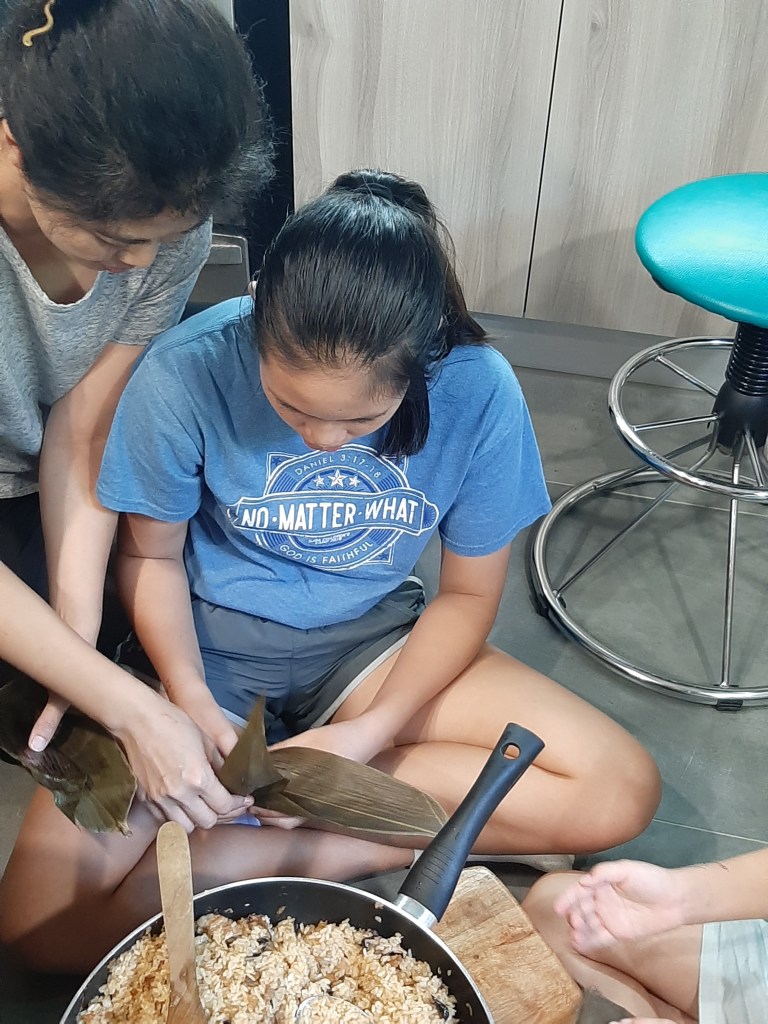
Photo Credit: MaDonna Maurer

Moral of my story? Don’t let pride stop you from building relationships with the people in your host country. They have so much to offer. And don’t forget that our children are watching us in how we respond to situations that seem a little difficult.

So, got a story to share on something you’ve learned or relearned? Please share in the comments below.


Bittersweet

Image by KathyBarclay from Pixabay

Bittersweet is a plant. It has bright colored berries that would seem sweet and juicy, but are actually toxic and harmful if eaten. Another definition of bittersweet is, “arousing pleasure tinged with sadness or pain” (Lexico). This is what most people are familiar with.

Life is generally like this. A little bit bitter. A little bit sweet. It mixes together and creates the story of our life. Sometimes the bitter seems toxic – and maybe it is, in which case, seek help – but most of the time, the bitter is just a time of growth.

My son just graduated from high school. Bittersweet was the one description I think I heard and felt through this whole experience.

Bitter – My first born completely finished this chapter of his childhood. That book is completed. It is shelved; to be looked at like a scrapbook full of memories. He’ll be leaving and living across an ocean soon; 12-24 hours away.

Sweet – We’re proud of his accomplishments. This new adventure is just beginning and it is exciting. Who will he become? How will he grow?

These two words together capture the feelings of a parent or sibling – and possibly even the graduate, as well.

But, aren’t most transitions “bittersweet”?

Bitter – packing, saying good-bye to places, saying good-bye to people, watching your children hurt

Sweet – maybe living closer to family, new adventure with new foods & culture, recognizing how many good friends you have

As this summer plays out and the time gets closer to board that plane with my oldest, my emotions teeter back and forth from feeling bitter and sad, to sweet and proud and then back to sad.

I want him to go, yet I don’t.

I want him to grow up, yet I want him to need me, to need his father.

I believe this is the dilemma of many parents. We work and endure those early years to train our kids to be responsible mature adults, but when the time comes to send them off we feel that this isn’t the right time. It’s too soon.

As a Christian, I wondered if the word “bittersweet” was in the Bible. I couldn’t find the word, but I found a passage where both words are used. Exodus 15:22-25. This is the point in the story where Moses had led the Israelites out of Egypt and crossed the Red Sea. They were headed into the Desert of Shur, where there was no water.

The people complained because the only water they found was at the place “Marah”, which was bitter.

Moses cried out to God.

God showed him a piece of wood.

Moses threw the piece of wood into the water.

Sweet water. Drinkable water.

It doesn’t say, but I’m guessing the crowds were happy once again – or at least relieved.

This little word search led me to an old story from long ago, in which God used a stick to make bitter water sweet.

My situation isn’t terrible. It’s not life-threatening, but it has some bitterness that is harder to walk through.

It requires trust.

Trusting my son.

Trusting God.

Right now sitting in my home where my son is just in the next room I can honestly say it’s easy to trust.

But,

I know that when “move-in” day comes and I drive away with him standing in the parking lot of his dorm, my eyes will be blurry from the streams of bittersweet tears as I put that trust into action.

How have you seen “bittersweet” play out in your own life?

Transition: Helping Your Children Through Change

Photo Credit by Canva

Transition is part of life. People move. Children come into the family. Special people and pets die. For those living overseas this rhythm of transition brings an odd normalcy, which one could easily sway or tap their foot.

In and out.

Come and go.

Up and down.  

Arrive depart.

Turn around and start again.

But, after a few years of this dance our minds stand guard. Emotions must stand against the wall and not step foot on the dance floor. Sometimes transition requires helping children through change.

If we find ourselves either in this awkward dance or stuck against the wall, what about our kids? They learn the dance early. How well they learn it or how to avoid it really depends on a few things. As parents we need to be mindful of them and how they are handling all the transitions, this includes children with special needs. My second child has Cri-du-Chat Syndrome and is mentally delayed. Though she can communicate, she is non-verbal. She has had her fair share of transitions as she spent most of her life outside of her passport country.

Her brother just graduated from high school last week. 

You can read the rest at Multicultural Kid Blogs where I am a guest writer today.